
How to Pass the FAA Part 107 Exam: Complete Study Guide (2026)
On this page
- Key takeaways
- What the Part 107 exam actually tests
- The Part 107 exam format and passing requirements
- How hard is the Part 107 test?
- A Part 107 study method that works
- Topic-by-topic Part 107 preparation checklist
- How to study sectional charts and airspace
- How to read aviation weather and METARs
- How to prepare for regulations and operating scenarios
- How to use Part 107 practice questions
- 7-day and 14-day Part 107 study plans
- How to know you're ready to schedule the exam
- How to register and schedule the official knowledge test
- What to expect on test day
- What to do after you pass (and if you don't)
- Self-study or a structured course?
- Common Part 107 study mistakes and misconceptions
- Frequently asked questions
- Free official FAA resources for the Part 107 exam
- Next steps
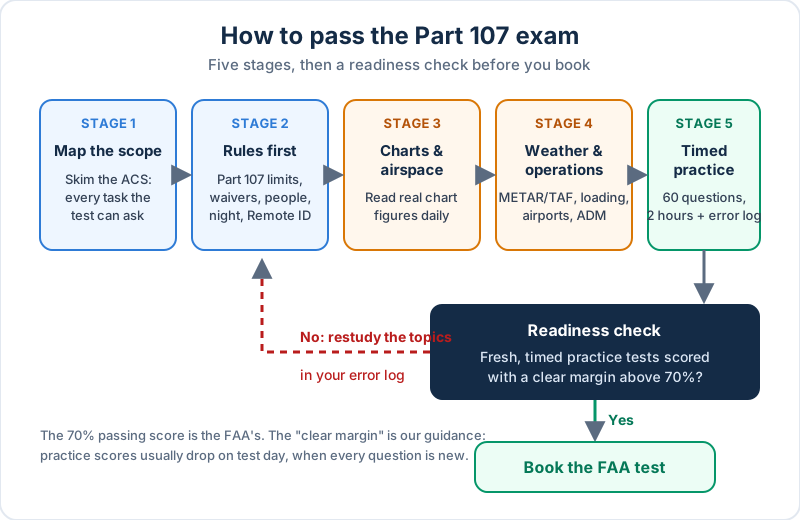
To pass the FAA Part 107 exam, learn the rules first, then put most of your study time into sectional charts and weather reports. Practice with the real FAA chart figures, not just with question banks. Finish with fresh, timed practice tests, and book the test only when you score comfortably above the 70% you need. Most people with no aviation background get there in two to four weeks of steady study. That's our teaching estimate, not an FAA figure.
The test is called Unmanned Aircraft General – Small (UAG). It has 60 scored multiple-choice questions, a 2 hours time limit and a 70% passing score, which works out to 42 correct answers. This guide explains what the test covers, how to study each part, how to know you're ready, and what happens on test day and after you pass.
DroneExamReady is an independent course provider. We're not affiliated with or endorsed by the FAA. Every rule and testing fact below links to the FAA source we checked it against.
Key takeaways
- The format: 60 scored questions with three answer choices each, 2 hours, 70% to pass. You take it in person at an FAA-approved testing center, not online.
- Where points are lost: reading sectional charts, decoding METAR and TAF reports, and rule details like the categories for operations over people.
- New since October 26, 2026: some chart questions show images from current FAA sectional charts that aren't in the printed testing supplement. Practice on real, current charts.
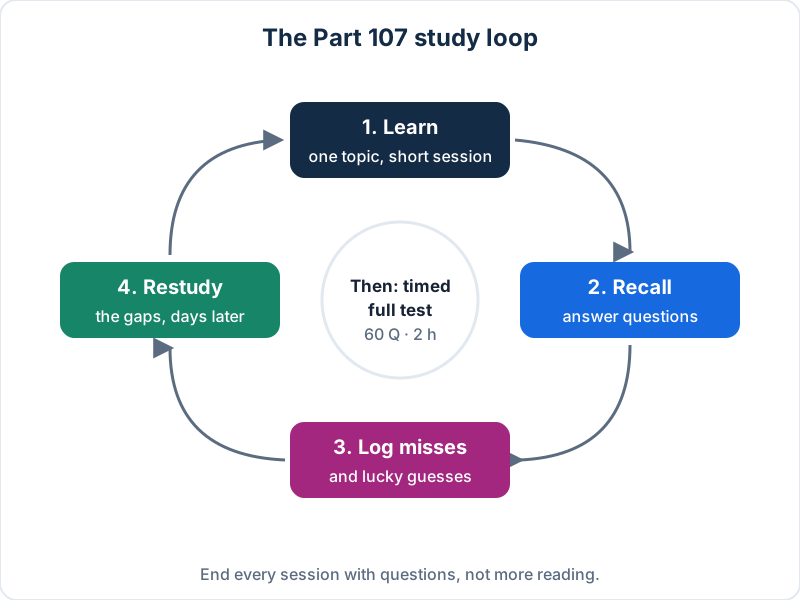
- The method: learn a topic, test yourself from memory, log every miss, then restudy it a few days later. Hours spent reading count for less than this loop.
- Ready means: fresh timed practice tests scored with a clear margin above 70%, not a date on the calendar.
What the Part 107 exam actually tests
The Part 107 knowledge test checks whether you can fly a small drone commercially without endangering crewed aircraft or people on the ground. It doesn't test stick skills. Almost every question asks you to apply a rule, read a chart, interpret a weather report or make a safe decision.
The FAA publishes exactly what the test can cover in the Remote Pilot Airman Certification Standards (opens in a new tab) (ACS). It groups the material into five knowledge areas:
- Regulations. 14 CFR Part 107: operating limits, certification, waivers, operations over people, night operations, Remote ID and accident reporting.
- Airspace classification and operating requirements. Class B, C, D, E and G airspace, special use airspace, temporary flight restrictions, and when you need an authorization.
- Weather. Sources of weather information, METAR and TAF reports, and how weather affects a small drone.
- Loading and performance. Weight and balance, load factor in turns, and density altitude.
- Operations. Radio communications, airport operations, emergency procedures, aeronautical decision-making, crew resource management, physiology and maintenance.
How the questions are weighted
Sources disagree. The ACS (FAA-S-ACS-10B, Appendix 1) gives older percentage ranges. PSI, the FAA's testing provider, publishes newer weights in its UAG candidate bulletin, which the FAA links from its October 2026 testing advisory.
| Knowledge area | ACS-10B range | PSI bulletin (eff. Sept 29, 2025) |
|---|---|---|
| Regulations | 15–25% | 48% |
| Airspace and operating requirements | 15–25% | 20% |
| Weather | 11–16% | 5% |
| Loading and performance | 7–11% | 2% |
| Operations | 35–45% | 25% |
Don't use either column as permission to skip a topic. Chart and weather questions are slow and easy to get wrong, so they cost more points than their share suggests. Our guide to how hard the Part 107 exam is covers the weighting dispute in more detail.
The Part 107 exam format and passing requirements
| What to know | Source | |
|---|---|---|
| Test name | Unmanned Aircraft General – Small (UAG) | FAA (opens in a new tab) |
| Questions | 60 scored, three answer choices each | FAA testing matrix (opens in a new tab) |
| Unscored questions | The test may include a few validation questions that don't count; PSI's bulletin says five | FAA testing matrix |
| Time | 2 hours, which includes any validation questions | FAA testing matrix |
| Passing score | 70%, or 42 of 60 correct | FAA testing matrix |
| Minimum age | 14 to take the test, 16 to hold the certificate | FAA testing matrix; FAA (opens in a new tab) |
| Endorsement needed | None, for the first attempt or a retest | FAA testing matrix |
| If you fail | Wait 14 days, then retest | FAA testing matrix |
| Where | An FAA-approved knowledge testing center, in person | FAA |
| Cost | About $175 per attempt (FAA estimate; confirm at checkout) | See Part 107 exam cost |
You're handed the Airman Knowledge Testing Supplement (FAA-CT-8080-2H), a book of charts and figures that many questions refer to. It's free on the FAA website (opens in a new tab), so practice with the same figures you'll see at the test. Since October 26, 2026, the FAA's testing advisory (opens in a new tab) says the UAG also includes "image-based questions not included in the test supplements," taken from current sectional charts. The supplement is still provided until the FAA announces it's being removed.
How hard is the Part 107 test?
For most people, the Part 107 test is very passable with focused study, but it isn't a common-sense quiz. The FAA's yearly knowledge test statistics show most UAG attempts pass: about 83% in calendar year 2025, counted per attempt, not per person. People who fail usually didn't practice the parts that need a skill: reading a chart excerpt, decoding a weather code, or reading a performance chart.
The FAA also publishes which test areas applicants miss most often. For the UAG, the most-missed area in its 2025 report was the declaration of compliance for operations over people, missed by about four in five applicants who were tested on it. It's a dry rule detail, and that's exactly why people skip it.
For question-by-question pacing and what the pass rate does and doesn't mean, see how hard the Part 107 exam is.
A Part 107 study method that works
Reading a study guide twice feels productive, but recognizing a fact isn't the same as recalling it under time pressure. Use this loop for every topic:
- Learn one topic in a short session (30–60 minutes).
- Recall it: answer practice questions without notes.
- Log every miss and every lucky guess in an error log: the question, the right answer, and why your answer was wrong.
- Restudy the error log two or three days later, before it fades.
When every topic has been through the loop, take a full timed practice test, then put the new misses back into the loop.
Study in this order. Each topic gives context for the next.
- Skim the ACS for 20 minutes so you know the full scope. Don't try to memorize it.
- Regulations. They're the most predictable points and they frame everything else.
- Airspace and sectional charts. Give these the most time, every day if you can.
- Weather. Theory first, then METAR and TAF decoding until it's routine.
- Loading, performance and operations. Airport procedures, radio calls, decision-making and physiology.
- Timed practice tests, then focused review of whatever your error log shows.
Topic-by-topic Part 107 preparation checklist
You're ready on a topic when you can do everything in the middle column without notes.
| Topic | You should be able to… | Common trap | Study it |
|---|---|---|---|
| Operating limits | State the altitude, speed, visibility and cloud-clearance limits, and when you may exceed 400 ft | Measuring altitude from sea level instead of above ground | Part 107 regulations |
| Operations over people | Name the four categories and what each requires | Mixing up the declaration of compliance (Categories 2 and 3) with an airworthiness certificate (Category 4) | Part 107 regulations |
| Night and reporting | State the anti-collision lighting rule and the 10-day accident-reporting threshold | Forgetting the $500 property-damage threshold | Part 107 regulations |
| Airspace | Identify each class on a chart and say when authorization is needed | Assuming uncontrolled airspace starts at the surface everywhere | Airspace classifications |
| Sectional charts | Read airport data blocks, shelf altitudes, obstacles and latitude/longitude | Confusing MSL and AGL numbers | Sectional charts |
| METAR and TAF | Decode wind, visibility, weather, clouds, temperature and altimeter; find the ceiling | Treating a scattered layer as a ceiling | METAR decoding |
| Weather theory | Explain fronts, stability, fog and thunderstorm stages | Ignoring density altitude | Aviation weather |
| Loading and performance | Read the load-factor chart and say how heat, height and humidity affect performance | Thinking a turn doesn't add load | Aviation weather |
| Airport operations | Read runway numbers, name traffic pattern legs, know CTAF procedures | Forgetting runway numbers are magnetic headings | Sectional charts |
| Decision-making and physiology | Name the five hazardous attitudes and their antidotes; use IMSAFE and PAVE | Picking the most decisive-sounding answer instead of the safest | Part 107 regulations |
How to study sectional charts and airspace
Sectional chart questions show you a chart excerpt and ask what airspace you're in, how high it goes, or what a symbol means. Learn to read five things, in this order:
- Airspace boundaries. Solid blue lines are Class B. Solid magenta lines are Class C. Dashed blue lines are Class D. Dashed magenta lines are Class E that starts at the surface. A fuzzy magenta band marks where Class E starts at 700 ft above ground. Outside it, Class E usually starts at 1,200 ft above ground.
- Altitude labels. A label like 40/15 inside Class B or C means the shelf goes from 1,500 ft up to 4,000 ft above sea level. SFC as the bottom number means it starts at the surface. A bracketed number such as [30] in a dashed box is a Class D ceiling: up to 3,000 ft MSL.
- Airport data blocks. These show the airport name and identifier, field elevation, lighting, the longest runway in hundreds of feet, and frequencies. A C in a circle marks the CTAF.
- Obstacles. The bold top number is the height above sea level (MSL). The number in parentheses is the height above the ground (AGL).
- Special use airspace. Prohibited (P), restricted (R), warning (W), alert (A), military operations areas (MOA) and military training routes.
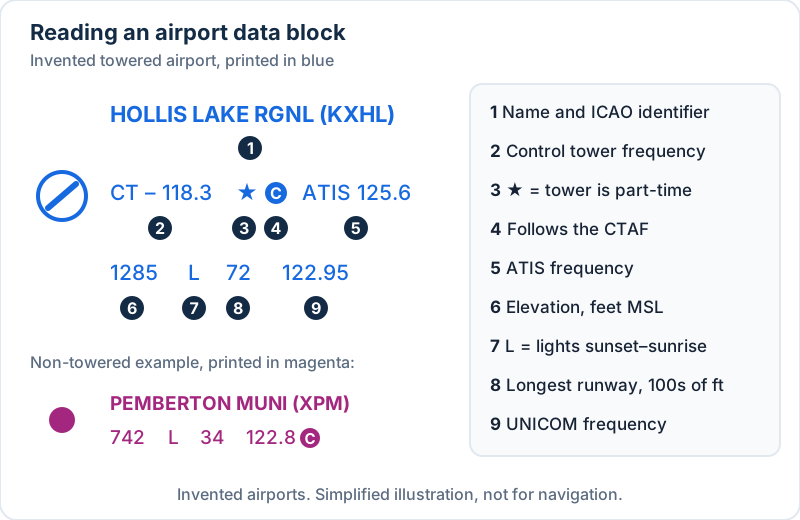
The habit that saves the most points is converting units. Chart altitudes are mostly MSL. Part 107's 400 ft limit is above ground level (AGL). If an airport sits at 1,000 ft MSL and a Class D ceiling reads [30], the Class D airspace reaches about 2,000 ft above that airport.
Since the test now shows real chart images, practice on current charts, not only the supplement. The FAA publishes every VFR sectional chart free as a PDF (opens in a new tab). Open the one for your area and name the airspace over five airports. Our sectional chart lesson and airspace guide walk through the symbols with diagrams.
How to read aviation weather and METARs
A METAR is an hourly airport weather report written in a fixed code. Learn it as a sequence, and most METAR questions become quick points. Here's an illustrative report:
KAUS 121753Z 18012G20KT 10SM BKN025 OVC040 28/19 A2992
| Code | Meaning |
|---|---|
KAUS |
Station: Austin-Bergstrom International Airport |
121753Z |
12th day of the month, 17:53 UTC (Zulu) |
18012G20KT |
Wind from 180° true at 12 knots, gusting to 20 |
10SM |
Visibility 10 statute miles |
BKN025 |
Broken clouds at 2,500 ft above ground. This is the ceiling |
OVC040 |
Overcast at 4,000 ft above ground |
28/19 |
Temperature 28 °C, dew point 19 °C |
A2992 |
Altimeter setting 29.92 inches of mercury |
Three points the test likes to check:
- The ceiling is the lowest broken (BKN) or overcast (OVC) layer, or vertical visibility. Few (FEW) and scattered (SCT) layers aren't ceilings.
- Cloud heights in a METAR are above ground level. Altitudes on a sectional chart are mostly above sea level.
- The temperature–dew point spread hints at fog: when the two get close, fog or low clouds become likely.
With a broken layer at 2,500 ft, Part 107's rule to stay 500 ft below clouds would allow up to 2,000 ft AGL. The 400 ft altitude limit is the tighter rule here. Questions often combine two rules like this.
TAF forecasts use the same codes, plus change groups like FM (from), TEMPO (temporary) and PROB30 (30% chance). For full walk-throughs, see our METAR decoding guide and aviation weather lesson. Practice on live reports from the Aviation Weather Center (opens in a new tab).
How to prepare for regulations and operating scenarios
Regulation questions are usually scenarios: a pilot wants to do X, so what does Part 107 require? Learn the numbers, then practice applying them. Here's the core set from 14 CFR Part 107 (opens in a new tab):
| Rule | Limit | Section |
|---|---|---|
| Aircraft weight | Under 55 lb at takeoff, including payload | §107.3 |
| Altitude | 400 ft AGL, or higher within 400 ft of a structure and no more than 400 ft above its top | §107.51 |
| Groundspeed | 87 knots (100 mph) | §107.51 |
| Visibility | At least 3 statute miles from the control station | §107.51 |
| Cloud clearance | 500 ft below and 2,000 ft horizontally from clouds | §107.51 |
| Line of sight | The remote pilot or a visual observer must see the aircraft unaided (glasses are fine) | §107.31, §107.33 |
| Night and twilight | Anti-collision lighting visible for 3 statute miles | §107.29 |
| Controlled airspace | Class B, C, D and surface-area Class E need FAA authorization (LAANC or DroneZone) | §107.41 |
| Alcohol | Not within 8 hours of drinking, or at 0.04 blood alcohol or higher | §107.27, §91.17 |
| Accident reporting | Within 10 calendar days, for serious injury, loss of consciousness, or more than $500 of damage to property other than the drone | §107.9 |
| Recurrent training | Within the previous 24 calendar months to keep flying | §107.65 |
Operations over people have four categories under §§107.110–107.145. Category 1 covers drones of 0.55 lb or less with no exposed rotating parts that could cut skin. Categories 2 and 3 need a drone listed on an FAA-accepted declaration of compliance. Category 4 needs an airworthiness certificate. This is the most-missed area on the test, so learn the table, not just the idea.
Many rules can be waived, but not all. The rules you can request a waiver for are listed in §107.205. Our Part 107 regulations lesson covers every subpart with diagrams.
How to use Part 107 practice questions
Practice tests are where most of your score comes from, but only if they measure what you know, not what you've memorized.
- Use fresh questions for scoring. After you've seen a question two or three times, it measures memory. Keep a set you haven't seen for your readiness checks.
- Time yourself. 2 hours for 60 questions is about two minutes each. Chart and weather questions take longer, so practice at test pace.
- Review every answer. Look at your correct answers too: a lucky guess is a miss you haven't found yet.
- Use the supplement figures. Many questions say "refer to Figure 20." Practice with the actual PDF.
- Read the question stem twice. Watch for NOT, EXCEPT and MOST, and for MSL versus AGL.
The FAA also publishes sample UAG questions (opens in a new tab). Some predate the April 2021 rule changes, so check answers about night flying and operations over people against current rules.
7-day and 14-day Part 107 study plans
Pick the schedule that fits your time, not the shortest one. These are outlines. The Part 107 study plan guide has day-by-day 1-, 2- and 4-week versions.
| 7-day intensive (about 3 hours a day) | 14-day standard (75–90 minutes a day) | |
|---|---|---|
| Days 1–2 | ACS skim, all regulations, operations over people | Days 1–3: ACS skim and regulations |
| Days 3–4 | Airspace and sectional charts, with supplement figures | Days 4–7: airspace and sectional charts |
| Day 5 | Weather theory, METAR and TAF, density altitude | Days 8–10: weather, METAR/TAF, loading and performance |
| Day 6 | Loading, airport operations, ADM; first full timed test | Days 11–12: operations and ADM; first two full timed tests |
| Day 7 | Error-log review; second and third timed tests | Days 13–14: error-log review; two fresh timed tests |
| Best for | Prior aviation exposure or time off work | Most people |
A 7-day plan doesn't leave time to fix weak areas. If day 6's practice test is under about 70%, move to the 14-day pace.
How to know you're ready to schedule the exam
Book the test when your results say so. Check yourself against this list:
- I've scored comfortably above 70% on at least two fresh, full-length, timed practice tests. We suggest aiming for 80% or more, since scores usually drop on test day.
- I can find the airspace class, floor and ceiling at any spot on a sectional chart excerpt.
- I can say which number on an obstacle symbol is AGL and which is MSL.
- I can decode a METAR without notes and name its ceiling.
- I can state the 400 ft, 87 knot, 3 mile and 500/2,000 ft limits and when each applies.
- I can name the four categories of operations over people and what each needs.
- I can read the load-factor chart and explain what density altitude does to performance.
- I can name the five hazardous attitudes and their antidotes.
- My error log has no topic with more than a couple of open misses.
If two or more boxes are unchecked, give it another week. A retest costs another fee and a 14-day wait, so a few extra days of study is usually the cheaper choice.
How to register and schedule the official knowledge test
- Create an IACRA account at iacra.faa.gov (opens in a new tab) to get your FAA Tracking Number (FTN). The FAA asks you to do this before registering for the test.
- Schedule the UAG with an FAA-approved knowledge testing center (opens in a new tab) through PSI, the FAA's testing provider. You'll need your FTN.
- Know the rules for changing your appointment. PSI's bulletin says cancellation or rescheduling notice must reach PSI at least 24 hours before the exam. Arriving late can forfeit the fee.
- Bring a government-issued photo ID.
The FAA says PSI will move to a new scheduling platform in the first quarter of 2027, and that PSI will contact applicants if the change affects an existing appointment. The full certification process is in our guide to getting a Part 107 license.
What to expect on test day
- Arrive early with your photo ID. Personal items, including watches, stay outside the testing room.
- The center gives you the testing supplement, scratch paper and something to write with. The test software has a built-in calculator.
- Pace yourself at about two minutes per question. Answer the ones you know, flag slow chart or math questions, and come back to them.
- Don't leave anything blank. Your score is the percentage you answer correctly, so a guess can't cost you points.
- Use the scratch paper first. Write down the numbers you're afraid of forgetting (400, 87, 3, 500/2,000, 10 days, $500) before you start.
- You'll get your result right away on an Airman Knowledge Test Report (AKTR). It lists ACS codes for any knowledge areas you missed.
What to do after you pass (and if you don't)
After you pass:
- Wait for your result to reach IACRA. The FAA says this can take up to 48 hours.
- In IACRA, start a new application: Pilot → Remote Pilot → Other Path Information. Enter the 17-digit exam ID from your AKTR and sign.
- The TSA runs a security background check. When it clears, the FAA emails instructions to print a temporary certificate. The permanent certificate comes by mail.
- Before flying commercially, register your drone (opens in a new tab) under Part 107 and make sure it meets the Remote ID rule.
- Every 24 calendar months, complete the FAA's free online recurrent training (ALC-677 on FAASafety.gov). See Part 107 recurrent training.
If you don't pass: the FAA requires a 14-day wait before a retest, and you pay the test fee again. Use the ACS codes on your AKTR as your study list. They point to exactly the areas you missed.
Self-study or a structured course?
You can pass Part 107 with free FAA materials. Plenty of people do. A course mostly saves time and adds structure. It doesn't contain secret content.
| Self-study with free FAA materials | Structured prep course | |
|---|---|---|
| Cost | Free, plus the test fee | Course fee plus the test fee (DroneExamReady is a one-time $129) |
| Materials | ACS, regulations, AC 107-2A, the 2016 FAA study guide, the supplement, sample questions | Lessons, worked examples and practice questions organized by topic |
| Structure | You build the plan and the error log yourself | A set order, with progress tracking |
| Practice | FAA samples (some predate 2021) and free tests online | Timed full-length exams and topic drills with explanations |
| Watch out for | Outdated material from before the April 2021 rule changes | Courses that teach to a question bank instead of to the charts |
| Best for | Disciplined learners with time | People who want a guided path and realistic timed practice |
Whatever you choose, check that your study material reflects the 2021 rule changes (night operations, operations over people, Remote ID, recurrent training) and the October 2026 switch to image-based chart questions.
Common Part 107 study mistakes and misconceptions
| Misconception | Reality |
|---|---|
| "It's common sense, I fly drones already." | Hobby experience helps with handling, but most questions test charts, weather codes and rule details you don't use as a hobbyist. |
| "Memorize the question bank and you'll pass." | Since October 26, 2026, chart questions can show new images from current charts. You need to read charts, not recognize answers. |
| "Weather is only 5%, so skip it." | Even a small share is several questions, and METAR questions are among the easiest points once you've learned the code. |
| "Altitudes on the chart are above ground." | Most chart altitudes are MSL. Part 107's 400 ft limit and METAR cloud heights are AGL. |
| "The 2016 FAA study guide is complete." | It predates the April 2021 changes. Use it with current regulations and AC 107-2A. |
| "I'll take the test and see how it goes." | A fail means another fee and a 14-day wait. Practice tests are the cheap way to see how it goes. |
| "I can take the Part 107 test online." | The initial UAG is taken in person at a testing center. Only the recurrent training is online. |
Frequently asked questions
Is the FAA Part 107 exam hard?
It's moderately hard for people new to aviation, mainly because of sectional charts and weather reports. The FAA's data shows most attempts pass: about 83% of UAG attempts in 2025. Focused study with timed practice tests prepares most people well.
Can I pass Part 107 without buying a course?
Yes. Every official source is free: the ACS, 14 CFR Part 107, AC 107-2A, the testing supplement and FAA sample questions. A course can save time and add structured practice, but you don't need one.
How many hours should I study for Part 107?
Most people new to aviation need about 15 to 25 focused hours over two to four weeks. Experienced pilots need less. This is our teaching estimate, not an FAA requirement. Let practice test scores decide when you're done.
How many questions are on the Part 107 test?
60 scored multiple-choice questions, each with three answer choices. The test may also include a few unscored validation questions; PSI's bulletin says five.
What score do I need to pass Part 107?
70%, which is 42 correct out of 60.
What happens if I fail the Part 107 exam?
You can retest after a 14-day waiting period, and you pay the test fee again. No instructor endorsement is required. Your test report lists the ACS codes for the areas you missed, so you know what to restudy.
Can I take the Part 107 exam online?
No. The initial knowledge test is taken in person at an FAA-approved testing center. The recurrent training that keeps you current every 24 months is online and free.
What's the most difficult Part 107 subject?
Most people find sectional charts hardest, followed by METAR and TAF decoding. The single most-missed area in the FAA's 2025 data was the declaration of compliance for operations over people.
How do I study sectional charts for Part 107?
Learn the airspace boundary styles, the MSL/AGL conventions, airport data blocks and obstacle symbols. Then practice daily on the testing supplement figures and on current sectional charts, which the FAA publishes free.
Is a paid Part 107 prep course worth it?
It depends on how you learn. A course is worth it if structure, explanations and realistic timed exams will save you study time or a retest. If you're disciplined and have time, the free FAA materials are enough.
How much does Part 107 certification cost?
The knowledge test is the main cost, about $175 per attempt according to the FAA. The certificate application in IACRA is free, and Part 107 drone registration is $5 per drone. Our Part 107 cost guide breaks it down.
How often do I need Part 107 recurrent training?
Every 24 calendar months. You complete the FAA's free online recurrent course (ALC-677) on FAASafety.gov. Your certificate doesn't expire, but you can't fly under Part 107 without current recency.
Free official FAA resources for the Part 107 exam
- Remote Pilot Airman Certification Standards (FAA-S-ACS-10B) (opens in a new tab): the official list of everything the test can ask. Use it as your checklist.
- 14 CFR Part 107 (eCFR) (opens in a new tab): the regulation itself. Read Subparts A through D at least once.
- Advisory Circular 107-2A (opens in a new tab): the FAA's plain-language guidance on applying Part 107.
- Airman Knowledge Testing Supplement (FAA-CT-8080-2H) (opens in a new tab): the chart and figure book you get at the test center.
- Remote Pilot Study Guide (FAA-G-8082-22) (opens in a new tab): free, but dated 2016, so check it against current rules.
- Pilot's Handbook of Aeronautical Knowledge (opens in a new tab): background on weather, performance, charts and decision-making.
- FAA sample UAG questions (opens in a new tab): real FAA-style items; some predate 2021.
- Become a Drone Pilot (FAA) (opens in a new tab): eligibility and the official certification steps.
Next steps
- Take the free Part 107 practice test to get a baseline score and see which areas need the most work.
- Pick a schedule from the Part 107 study plan guide and start with the regulations.
- When you're ready for structured lessons and timed full-length exams, look at the complete Part 107 course.