
Part 107 Exam Cost: Every Fee for Your FAA Drone License
The Part 107 exam costs approximately $175, the fee FAA-approved testing centers charge for the UAG knowledge test, paid to the testing vendor, PSI. The FAA charges nothing to issue the certificate, and recurrent training every 24 months is free online. Part 107 drone registration is $5 per drone; a retake means paying the full fee again.
The Part 107 exam costs approximately $175, the fee FAA-approved testing centers charge for the UAG knowledge test. That's the only required cost of the certificate itself; the FAA charges nothing to issue it.
You pay the $175 to the FAA's testing vendor, PSI, when you book. Processing your application, the TSA background check, the temporary and permanent certificates, and the recurrent training you'll need every 24 calendar months are all free. The other costs that matter are $5 per drone for Part 107 registration and, if it happens, a second test fee after a failed attempt.
People budget for this like it's a professional license with renewal dues. It isn't. Below is every fee, what's free, where money gets wasted, and three realistic budgets.
Key takeaways
- Test fee: approximately $175 per attempt, per the FAA, paid to PSI. Not to the FAA.
- FAA fees: $0 for the application, TSA check, and certificate. The certificate doesn't expire, so there's no renewal fee.
- Recurrent training: free online on FAASafety.gov, every 24 calendar months.
- Retake: wait 14 calendar days and pay the full fee again.
- Drone registration: $5 per drone under Part 107, valid three years.
- Avoidable losses: late cancellations, late arrival, or the wrong ID can forfeit your fee.
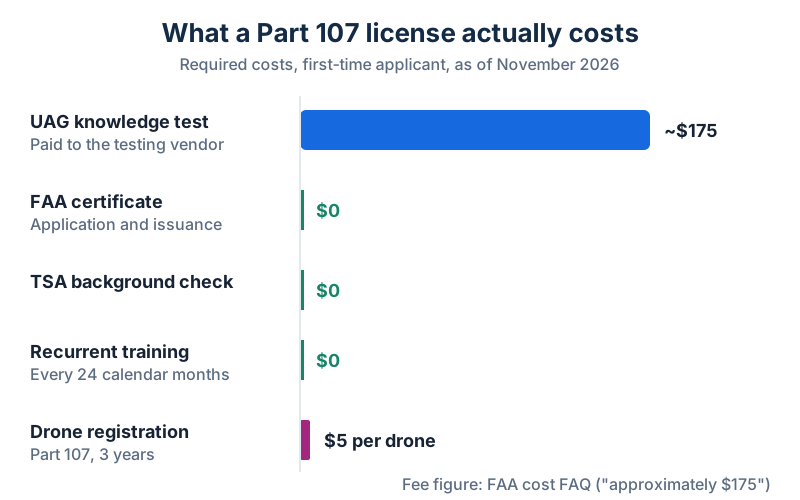 Required costs for a first-time Part 107 applicant. The test fee is the only significant one.
How much does the Part 107 test cost?
The FAA's cost FAQ (opens in a new tab) gives one figure: "Knowledge Testing Centers charge approximately $175 to people seeking to take the initial aeronautical knowledge test." That test is officially the Unmanned Aircraft General – Small (UAG): 60 scored questions, 2 hours, 70% to pass.
PSI also sells FAA knowledge test vouchers to organizations, such as employers, schools, and agencies buying for staff or students, at $175.00 per voucher plus applicable tax, valid for one year from issue. If your employer is paying, ask whether they already hold vouchers before you put the fee on your own card.
What the fee covers
- One sitting of the UAG at an FAA-approved testing center
- Use of the testing supplement, scratch paper, a writing instrument, and the software's built-in calculator, all provided at the center
- Your printed Airman Knowledge Test Report (AKTR), which you can reprint free from your PSI account later
What the fee doesn't cover
- A second attempt if you fail
- A new appointment if you miss yours, arrive late, or cancel inside the deadline
- Anything after the test: the FAA side of the process is a separate, free step in IACRA
Why the FAA says "approximately"
The FAA doesn't set the fee. The testing vendor does, under its contract with the FAA, and the FAA's wording leaves room for that. So treat $175 as the expected number and confirm the final amount, including any tax, at checkout. If you're reading this well after November 2026, check the FAA FAQ again; it's the one official source for the figure.
What the FAA itself charges: nothing
Once you pass, you apply for the certificate on Form 8710-13 in IACRA. The full sequence is in how to get a Part 107 license. None of it costs money.
| Step | FAA fee |
|---|---|
| IACRA profile and FAA Tracking Number (FTN) | $0 |
| Remote Pilot Certificate application (Form 8710-13) | $0 |
| TSA security background check | $0 |
| Temporary certificate (print from IACRA) | $0 |
| Permanent certificate (mailed) | $0 |
| Renewal | None; the certificate doesn't expire |
| Replacement if lost or destroyed | $2 per certificate, per the FAA's certificate replacement page (opens in a new tab) |
If anyone tries to charge you an "FAA license fee" or a "certificate processing fee," that's a third party's service charge, not a government cost.
How much does a Part 107 retake cost?
A retake costs the same as the first attempt: approximately $175, because each sitting is a separate registration. The rules for retesting come from 14 CFR 107.71 (opens in a new tab) and the FAA testing matrix (opens in a new tab):
- You must wait 14 calendar days after the failed attempt.
- You bring the failed AKTR to the testing center. The proctor scans it and destroys it.
- No instructor endorsement is required. That's unusual among FAA tests; most pilot tests require an instructor sign-off after a failure.
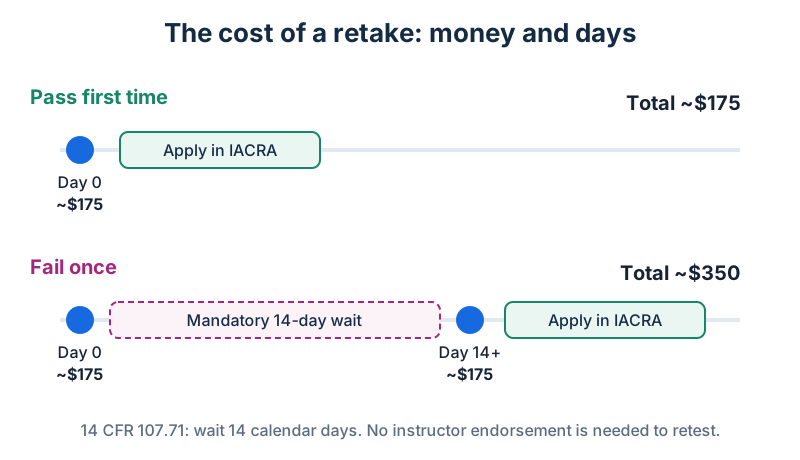 A failed attempt roughly doubles the test cost and adds at least two weeks.
The real cost of failing is time
The second fee hurts, but the delay usually costs more. If you're getting the certificate for a job, a failed attempt means at least 14 days of waiting, then the IACRA and TSA processing you were already waiting for. For a freelancer turning down two weeks of paid flights, the test fee is the small number.
That's the honest case for preparing properly before you book: less about pass-or-fail anxiety, more about not paying twice in money and calendar. How hard the Part 107 exam is covers how to judge your readiness.
Fees you can lose: rescheduling, no-shows, and ID problems
This is where people quietly throw away $175. From PSI's current UAG applicant bulletin:
- Cancelling or rescheduling: your notice must be received 24 hours before the exam time. A voicemail isn't an acceptable cancellation; by phone, you have to speak with a customer service representative.
- Late arrival: PSI recommends arriving at least 15 minutes early. If you arrive late, you may not be admitted and may forfeit your examination registration fee.
- Wrong ID: showing up without all the required identification is treated as a missed appointment. Your ID must be valid, current, and show your photo, date of birth, signature, and physical residential address.
- Emergency closures: if severe weather or another emergency closes the site, PSI reschedules you at no additional charge.
Two habits prevent all of this. Check your ID against the requirements the day you book, not the morning of the test. And set a reminder 48 hours before your appointment, so you still have a day to reschedule if something comes up.
Is Part 107 recurrent training free?
Yes. Since April 6, 2021, the FAA has offered recurrent training as a free online course (opens in a new tab) instead of the old in-person recurrent test. Most remote pilots take ALC-677 on FAASafety.gov (opens in a new tab), whose course page lists "Cost: No." Part 61 pilots with a current flight review can take ALC-515 instead, also free.
You need to complete it every 24 calendar months to keep exercising your certificate's privileges. "Part 107 renewal" services that charge for this are selling you a free course. Details and deadlines are in Part 107 recurrent training.
How much does drone registration cost?
Drone registration isn't part of the exam, but it's a required cost if you'll fly commercially. According to the FAA's registration page (opens in a new tab):
| Registration type | Cost | Covers | Valid for |
|---|---|---|---|
| Part 107 | $5 | One drone | 3 years |
| Exception for Limited Recreational Operations | $5 | All drones in your inventory | 3 years |
Registrations can't be transferred between the two types, and a drone registered as recreational can't be flown under Part 107. If you're moving from hobby flying to paid work, budget $5 for each drone you'll use for work. Under Part 107, even drones under 250 grams need registering, and registered drones must comply with Remote ID. Not sure which rules apply to you? See Part 107 vs. recreational flying.
Part 107 vs. recreational flying: what each costs
If you're deciding whether you need Part 107 at all, cost is rarely the deciding factor, but it helps to see both side by side.
| Part 107 (Remote Pilot Certificate) | Recreational (Exception for Limited Recreational Operations) | |
|---|---|---|
| Knowledge requirement | UAG test, approximately $175 | TRUST, free online |
| Where you take it | In person at an FAA-approved testing center | Online with an FAA-approved TRUST administrator |
| Registration | $5 per drone, 3 years | $5 for all your drones, 3 years |
| Ongoing training | Free online recurrent training every 24 calendar months | None beyond keeping your TRUST certificate |
| Paid or business flying allowed | Yes | No |
The recreational route is cheaper, but the moment a flight has any business purpose, it's off the table. Selling a single photo, filming for a client, or flying for your employer all fall under Part 107. Paying the $175 is far cheaper than an enforcement action for flying a commercial job without a certificate.
Study materials: free vs. paid
You can prepare with only free FAA material. Here's what's available at no cost:
- The Remote Pilot ACS (FAA-S-ACS-10B), which defines everything the test can ask
- The testing supplement (FAA-CT-8080-2H), free from the FAA's testing supplements page (opens in a new tab); the same figures appear on test day
- AC 107-2A, the FAA's guidance on complying with Part 107
- The Remote Pilot Study Guide (FAA-G-8082-22), useful but dated 2016, before the 2021 rule changes
- The eCFR text of Part 107, the final word on any rule question
- PSI's free sample test, under "Exam Resources" on PSI's FAA site
What a paid course buys you is structure, plain-language explanations, and realistic timed practice, not secret content. For reference, the DroneExamReady Part 107 course is a one-time $129, and our free Part 107 practice test costs nothing. Whatever you choose, compare it to the cost of a retake: another fee plus at least 14 days.
One 2026 change affects how you study for free. Since October 26, 2026, the UAG has included some image-based questions using current sectional chart images that aren't in the printed supplement. Practicing only on the supplement's figures leaves a gap; practice on current charts too. The sectional charts guide covers how.
Other costs people forget
None of these are FAA fees, but they show up in real budgets:
- Travel to the testing center. Centers cluster around airports and cities. In rural areas, a round trip can cost more in fuel and time than you'd expect.
- Time off work. The test is up to 2 hours, plus check-in and travel. Available days and times vary by center, so check before you request the day off.
- A lost score report. Free. For tests taken on or after January 13, 2020, you reprint the AKTR from your PSI account.
- Remote ID. If your drone doesn't broadcast Remote ID itself, you'll need a broadcast module. Prices vary by model.
- Insurance. Part 107 doesn't require liability insurance, but many clients do. Price it before you quote your first job.
- Waivers and airspace authorizations. LAANC and FAADroneZone airspace authorizations and waiver applications don't carry an FAA fee.
Worked examples: three realistic Part 107 budgets
| Item | A: Photographer, 2 drones, passes first time | B: Fails once, 1 drone | C: Private pilot (Part 61 path), 1 drone |
|---|---|---|---|
| UAG test | ~$175 | ~$350 (two attempts) | $0 (takes free ALC-451 instead) |
| FAA certificate and TSA check | $0 | $0 | $0 |
| Part 107 registration | $10 | $5 | $5 |
| Free FAA study material | $0 | $0 | $0 |
| Required total | ~$185 | ~$355 | $5 |
| Extra time lost to retesting | None | At least 14 days | None |
Pilot C is the cheapest path but only exists if you already hold a Part 61 pilot certificate (other than student pilot) with a flight review in the previous 24 calendar months. They complete the free ALC-451 course and have a FSDO, designated pilot examiner, airman certification representative, or CFI validate their identity. No testing center fee applies.
The long view: three years of costs
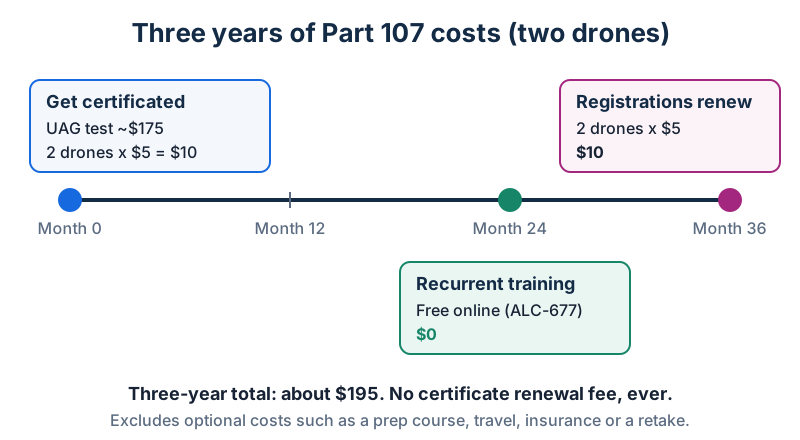 After the first year, ongoing FAA costs are almost nothing.
For pilot A, the next FAA cost after the first month is nothing at the 24-month recurrent deadline and $10 at three years, when both drone registrations come up for renewal. Compare that with any professional license that has annual dues.
Two timing details are worth noting. Your recurrent training clock and your registration clock run independently: currency counts in calendar months from the test or training, while each drone's registration runs three years from when you registered it. If you buy a third drone in year two, its $5 registration starts its own three-year term. Track the dates separately. A single calendar entry for "drone renewals" is how people end up flying an expired registration or a lapsed currency without noticing.
Who pays when an employer sends you
If your company needs you certificated, the conversation is simple because the numbers are small. Ask three questions before you book: will they pay the fee directly or reimburse it, do they already hold PSI vouchers, and will they cover a retake if one is needed. Get the answer in writing if the retake matters to you. The certificate is issued to you personally, not to the company, so it goes with you if you change jobs.
How to avoid paying for the Part 107 test twice
- Take a timed, full-length practice exam before you book, and score comfortably above 70% on questions you haven't seen.
- Practice chart questions on current sectional excerpts, not just the supplement.
- Book a slot with a buffer so a reschedule doesn't land inside the 24-hour window.
- Check your ID tonight: photo, date of birth, signature, residential address, not expired.
- Plan to arrive 15 minutes early, and leave your phone, watch, and pens in the car.
Common mistakes
- Budgeting for an FAA "license fee." There isn't one. The test fee goes to PSI.
- Registering work drones as recreational to save $5 per drone. That registration doesn't cover Part 107 flights.
- Paying for "renewal." Recurrent training is online and free.
- Missing the 24-hour reschedule window, or cancelling by voicemail.
- Booking before you're ready. A failed attempt costs a second fee and at least 14 days.
Frequently asked questions
How much does the Part 107 test cost in 2026?
The FAA says knowledge testing centers charge approximately $175 for the initial UAG test. You pay it to PSI, the FAA's testing vendor, when you schedule. PSI's organizational voucher price is $175.00 plus applicable tax. Confirm the final amount at checkout, since the vendor, not the FAA, sets the fee.
Is the Part 107 certificate itself free?
Yes. The FAA charges nothing to create your IACRA profile, process Form 8710-13, run the TSA background check, or issue the temporary and permanent certificates. The certificate doesn't expire, so there's no renewal fee. The only FAA charge you're likely to see is $2 if you ever need a replacement for a lost or destroyed certificate.
How much does it cost to retake the Part 107 exam?
A retake costs the full test fee again, approximately $175, because each attempt is a separate registration. You must wait 14 calendar days after failing and bring the failed AKTR to the testing center. No instructor endorsement is needed. The bigger cost is usually time: at least two weeks added to your timeline before you can apply.
How much does Part 107 renewal cost?
Nothing. A Part 107 certificate doesn't expire, and the recurrent training that keeps you current every 24 calendar months is a free online course on FAASafety.gov: ALC-677 for most pilots, or ALC-515 for Part 61 pilots with a current flight review. There's no in-person recurrent test anymore; it was replaced in April 2021.
Do I get my money back if I cancel the Part 107 exam?
PSI lets you cancel and reschedule if your notice is received at least 24 hours before your exam time, and it doesn't accept voicemail as a cancellation. If you miss the appointment, arrive late, or show up without proper ID, you may forfeit the fee. Check PSI's current policy when you book, since the vendor sets these terms.
Does it cost extra to register my drone for Part 107?
Yes, $5 per drone, valid for three years, through FAADroneZone. That's separate from the test fee and the certificate. Recreational registration also costs $5 but covers all your drones; it can't be used for Part 107 flights, and registrations can't be transferred between the two types.
Can I use a voucher to pay for the Part 107 exam?
Yes, if an organization buys one for you. PSI sells FAA knowledge test vouchers to employers, schools, and agencies at $175.00 each plus applicable tax, valid for one year from issue. Vouchers are delivered electronically once paid. Individuals normally just pay when they schedule, so a voucher mainly matters when someone else is covering the cost.
What's the cheapest way to get a Part 107 license?
Study with the free FAA material, practice until you're consistently passing timed exams, and pass on the first attempt: about $175 for the test plus $5 per drone. If you already hold a Part 61 pilot certificate with a current flight review, the free ALC-451 course replaces the test, so the certificate costs nothing at all.
Bottom line
Plan on about $175 for the test, $5 for each drone you'll fly commercially, and nothing to the FAA. Spend your effort on passing the first time and protecting your appointment; those are the only places this gets expensive. The Part 107 study plan shows how to schedule your prep so you book when you're ready.
Sources
- FAA — How much does it cost to get a remote pilot certificate? (FAQ)
- FAA — Become a Certificated Remote Pilot (no-cost recurrent courses)
- FAA — Airman Knowledge Testing Matrix (revised September 25, 2026; UAG retest rules)
- eCFR — 14 CFR Part 107, Subpart C (including §107.71 Retesting after failure)
- FAA — How to Register Your Drone (registration fees)
- FAA — Operations Over People General Overview (free online recurrent training from April 6, 2021)
- FAASTeam — ALC-677 Part 107 Small UAS Recurrent (Cost: No)
- FAA — Replace an Airmen Certificate ($2 replacement fee)
- FAA — Airman Knowledge Testing Supplements (free download)
- PSI — Services for FAA Testing Programs (voucher pricing)
- PSI — Unmanned Aircraft General – Small Applicant Information Bulletin (effective September 29, 2025)