
How Hard Is the Part 107 Exam? Questions, Passing Score, Format
The Part 107 exam is moderately hard. It has 60 scored multiple-choice questions with three choices each, a 2-hour limit and a 70% passing score, so you need 42 correct. FAA data shows about 83% of 2025 attempts passed. Most lost points come from sectional charts, weather reports and operations-over-people details, not basic drone rules.
The Part 107 exam is moderately hard: 60 multiple-choice questions, 2 hours, and a 70% passing score, which means 42 correct. The FAA's own data shows about 83% of attempts passed in 2025. It's very passable, but it isn't common sense. Most lost points come from reading sectional charts, decoding weather reports and remembering operations-over-people details, not from basic drone rules.
Key takeaways
- Format: 60 scored questions, three answer choices each, 2 hours, 70% to pass (42 of 60). PSI adds 5 unscored validation questions inside the same 2 hours.
- Pass rate: the FAA reports an 82.96% pass rate on 73,914 UAG tests in 2025, with an average score of 79.31%. That average is only about 9 points above passing.
- Hardest areas: sectional charts, METAR/TAF decoding, supplement figures, and operations over people. One operations-over-people code was missed 78.58% of the time in FAA data.
- New since October 26, 2026: some chart questions use on-screen images from current sectionals that aren't in the printed testing supplement.
- Weighting is disputed: the FAA's 2021 ACS and PSI's 2025 bulletin give very different topic percentages. Study for both.
- Failing isn't final: wait 14 days, bring your failed report, pay again and retest. No instructor sign-off needed.
Part 107 test format at a glance
The test's official name is Unmanned Aircraft General – Small, code UAG. Here's what the FAA's Airman Knowledge Testing Matrix (opens in a new tab) (revised September 25, 2026) and PSI's candidate bulletin say:
| Item | Detail |
|---|---|
| Official name | Unmanned Aircraft General – Small (UAG) |
| Scored questions | 60 |
| Unscored validation questions | 5, per PSI's bulletin (the FAA matrix says "may include" without a count) |
| Answer format | Multiple choice, three options, one correct answer |
| Time allowed | 2.0 hours, including validation questions |
| Passing score | 70%, which is 42 of 60 correct |
| Minimum age to test | 14 (you must be 16 to be issued the certificate) |
| Endorsement needed | None, including for retakes |
| Figures | FAA-CT-8080-2H testing supplement (2018), provided at the test, plus some on-screen images |
| Retest wait after failure | 14 calendar days (14 CFR 107.71 (opens in a new tab)) |
| Typical cost | About $175 paid to PSI (see Part 107 exam cost) |
60 questions or 65?
Both numbers are right. You're scored on 60. PSI's bulletin says 5 more validation questions are mixed in so the FAA can test new items before they count. You can't tell which ones they are, so treat all 65 as real. The 2-hour limit covers all of them.
What changed in October 2026
The FAA's October 2026 Airman Testing Community Advisory (opens in a new tab) says that as of October 26, 2026, the UAG began featuring image-based questions not included in the test supplement. The images come from current FAA VFR sectional charts. You'll see the chart excerpt on screen next to the question instead of flipping to a figure in the book.
The supplement hasn't gone away. The FAA says the date for removing printed supplements from test centers "has not yet been set," and candidates keep access to the supplement until then. So, for now, expect both: supplement questions ("Refer to FAA-CT-8080-2H, Figure 26, area 2") and on-screen chart images.
Two practical effects. First, you can't memorize the handful of supplement chart figures and call it done. You need to read any sectional excerpt. Second, newer charts mean current symbols, frequencies and airspace shapes, so practice on recent chart excerpts too.
How many questions do you need to get right to pass?
You need 42 correct out of 60. Put the other way, you can miss up to 18 scored questions and still pass. The score on your report is simply the percentage you got right on the scored items.
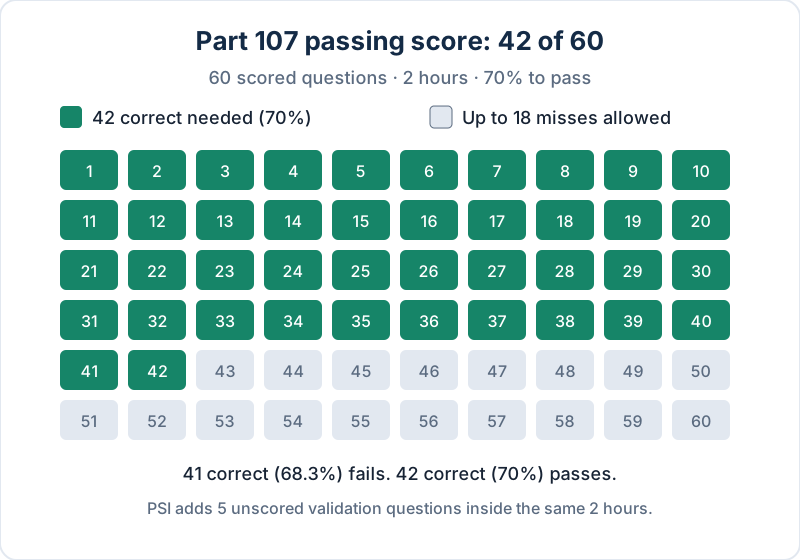 The passing line in plain numbers: 42 correct passes, 41 doesn't.
A few scoring details people ask about:
- There's no penalty for a wrong answer. A blank is just as wrong as a bad guess, so never leave one empty. With three choices, a blind guess has a 1-in-3 chance. Eliminate one wrong choice and it's 1-in-2.
- You get your result right away. The proctor hands you a printed Airman Knowledge Test Report (AKTR) when you finish.
- The report lists ACS codes for what you missed, not the questions themselves. A code like
UA.II.A.K1points to an element in the FAA's Remote Pilot Airman Certification Standards (opens in a new tab). - A passing report is good for 24 calendar months for applying for your certificate. Don't sit on it. The application steps are in how to get a Part 107 license.
Is the Part 107 test hard? What the FAA's pass rate says
You don't have to guess. The FAA publishes annual knowledge test statistics on its Airman Knowledge Test Statistics (opens in a new tab) page. Here's the UAG next to the private pilot written test for comparison:
| Test (calendar year) | Tests taken | Pass rate | Average score |
|---|---|---|---|
| UAG, 2025 | 73,914 | 82.96% | 79.31% |
| UAG, 2024 | 67,576 | 84.20% | 79.95% |
| Private Pilot Airplane, 2025 | 44,657 | 89.56% | 81.64% |
Source: FAA 2025 Airman Knowledge Tests report (opens in a new tab) and the 2024 report on the same index page.
How to read this honestly:
- These are attempts, not people. A person who fails once and passes on the retake shows up twice. The FAA doesn't publish a first-try pass rate for the UAG in these reports, so nobody can tell you "X% pass on the first attempt" from official data.
- The average score is the more telling number. At 79.31%, the typical test taker lands only about five questions above the 42-correct line. Most people don't fail by a mile. They pass narrowly or fail narrowly.
- A lower pass rate than the private pilot written is interesting, but it's not proof the UAG is harder. Private pilot applicants usually have an instructor and a structured ground school. Plenty of UAG candidates walk in after a weekend of videos.
My read after teaching this material: the test isn't hard in the "only geniuses pass" sense. It's hard in the "you can't wing it" sense. People who study charts and weather properly tend to be fine. People who rely on drone experience and common sense are the ones in the bottom fifth.
The single most-missed Part 107 topic
The FAA also publishes a quarterly list of ACS codes missed more than 70% of the time. In the report covering July 2024 through June 2025 (opens in a new tab), one UAG code made the list: UA.I.E.K13, missed 78.58% of the time. In the ACS, that code is Declaration of Compliance (DoC), under Operations Over People.
That tells you something useful. The hardest single topic isn't a chart. It's a dry regulatory detail that most people skim: which categories of operations over people need a drone with an FAA-accepted declaration of compliance (Categories 2 and 3), and which need an airworthiness certificate (Category 4). Learn the four categories cold. Our FAA regulations overview is a good starting point.
What's on the Part 107 test, and why the weighting is disputed
The knowledge areas come from 14 CFR 107.73 (opens in a new tab), and the FAA organizes them into five ACS areas. The problem is that two current documents give very different splits:
| ACS area | FAA-S-ACS-10B, Appendix 1 (April 2021) | PSI UAG bulletin (Sept 2025, from a 2025 job task analysis) | Approx. questions of 60 under PSI |
|---|---|---|---|
| I. Regulations | 15–25% | 48% | about 29 |
| II. Airspace & requirements | 15–25% | 20% | about 12 |
| III. Weather | 11–16% | 5% | about 3 |
| IV. Loading & performance | 7–11% | 2% | about 1 |
| V. Operations | 35–45% | 25% | about 15 |
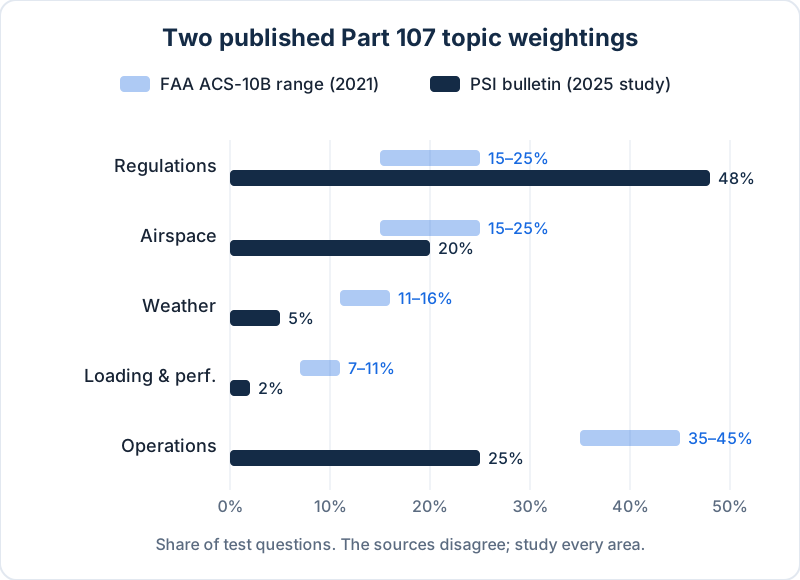 The two published weightings side by side. Regulations is the big disagreement.
Which one is right? As of November 2026, the FAA hasn't published a revised ACS (10B is still the current Remote Pilot ACS), but PSI's bulletin is newer, and the FAA's own October 2026 advisory links to the UAG candidate bulletin. Our best reading is that the PSI split reflects the live test. We can't confirm that from an FAA document, though, so here's the practical advice:
- Regulations deserve the most time either way. Under PSI's numbers, they're nearly half the test.
- Don't drop weather or loading. Even three or four questions can be the difference between 41 and 42. And chart and weather skills show up inside "regulations" and "airspace" questions too.
- Use the ACS as your checklist regardless of weighting. It's the official list of what can be tested.
For a topic-by-topic breakdown, use the Part 107 study guide.
What actually makes the Part 107 exam hard
1. Sectional charts (now with on-screen images)
Many questions show a piece of a VFR sectional chart and ask about airspace class, floors and ceilings, obstacle heights, airport data or special-use airspace. The symbols are dense, and color and line style carry meaning: solid blue is Class B, solid magenta is Class C, dashed blue is Class D, dashed magenta is a Class E surface area. Start with how to read sectional charts and airspace classifications.
The classic trap: a Class C shelf labeled 40/15 has a floor of 1,500 ft MSL, not AGL. To know whether your flight enters it, subtract the ground elevation. Obstacle symbols work the same way: the top number is MSL, the number in parentheses is AGL.
2. METAR and TAF weather reports
You'll see raw coded weather such as KXYZ 121853Z 27012G20KT 6SM BR OVC008 12/11 A2992 and get asked about conditions. You need the field order, the abbreviations and the units. Wind direction is relative to true north, and cloud heights are in hundreds of feet AGL. See how to read a METAR and the wider aviation weather primer.
3. Supplement figures and the load factor chart
The FAA-CT-8080-2H supplement (listed as current on the FAA supplements page (opens in a new tab)) holds the charts, weather figures and graphs the test refers to, including the load factor chart. These questions are slow because you have to find the right figure and area before you can start. It's a shared book for several pilot tests, so it's full of figures you'll never be asked about. Practice finding your way around it.
4. Operations over people and other rule details
As the FAA's miss data shows, the detail-heavy rules hurt: the four categories, declarations of compliance, operations over moving vehicles, Remote ID broadcast options, and when a report is due. These look easy because the words are familiar. They aren't easy when two answer choices differ only by category number.
5. Answer choices that are almost right
With only three options, the wrong answers are usually plausible. Common patterns: the right number in the wrong unit (MSL vs. AGL, knots vs. mph), the right authority with the wrong action, or a rule that's true for manned aircraft but not under Part 107. Read the whole stem, especially qualifiers like "according to 14 CFR part 107," "first" and "except."
What's easier than people expect
Basic operating limits (400 ft, 87 knots, 3 statute miles, 500 ft below and 2,000 ft horizontally from clouds), crew resource management, aeromedical factors and decision-making questions are straightforward once studied. They're where you build your cushion.
Try three exam-style Part 107 questions
Question 1: A METAR for the airport next to your job site reads KXYZ 121853Z 27012G20KT 6SM BR OVC008 12/11 A2992. Under Part 107's default rules, what is the highest you could fly while keeping the required cloud clearance?
A. 300 ft AGL B. 400 ft AGL C. 800 ft AGL
Show answer
Answer: A. OVC008 is an overcast layer at 800 ft AGL. Under 14 CFR 107.51 you must stay at least 500 ft below clouds, so 800 − 500 = 300 ft AGL. Visibility of 6 SM meets the 3 SM minimum. B ignores cloud clearance, and C puts the drone in the cloud base.
Question 2: You plan to fly under a Class C outer shelf labeled 40/15. Ground elevation at your site is 1,250 ft MSL. How high can you fly without needing airspace authorization?
A. Up to 400 ft AGL B. Below 250 ft AGL C. Below 1,500 ft AGL
Show answer
Answer: B. The shelf floor is 1,500 ft MSL. 1,500 − 1,250 = 250 ft, so you must stay below 250 ft AGL to remain outside Class C. A ignores the shelf, and C reads the MSL floor as AGL.
Question 3: You want to fly over people under Category 2. What must be true of the drone?
A. It must be listed on an FAA-accepted declaration of compliance for Category 2. B. It must have an FAA airworthiness certificate. C. It must weigh 0.55 lb or less.
Show answer
Answer: A. Category 2 and Category 3 operations need a drone listed on an FAA-accepted declaration of compliance. B describes Category 4. C describes part of Category 1, which needs no declaration. This is the operations-over-people topic the FAA says candidates miss most often.
How long is the Part 107 test, and how should you pace it?
You get 2 hours. With 65 items (60 scored plus 5 validation), that's a little under 2 minutes each. Most rules questions take 20 to 40 seconds, which banks time for chart and weather items that can take 3 or 4 minutes.
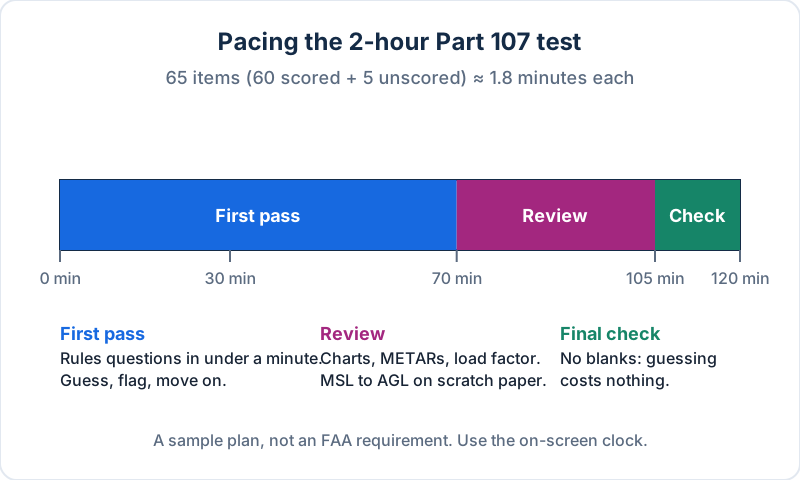 One workable pacing plan. Your exact split will vary, but always leave time for a final check.
A simple three-pass plan:
- First pass (about 70 minutes): answer everything you can quickly. On any question needing a long chart search or calculation, pick your best answer, flag it and move on.
- Review pass (about 35 minutes): return to flagged questions with the time you banked. Do MSL-to-AGL math on scratch paper.
- Final check (about 15 minutes): make sure nothing is blank. Change an answer only if you can say exactly why the first one was wrong.
Test-day logistics help too. The test center gives you the supplement, scratch paper and a writing instrument, and PSI's software has a built-in four-function calculator. Watches aren't allowed in the room, so use the on-screen clock.
How to tell if you're ready for the Part 107 exam
- You score well above passing on several fresh, timed, full-length practice tests. Given that the average real score is about 79%, aim for a steady margin above that, not a single 72%.
- You answer chart and weather questions without guessing. If your total is fine but you're guessing on sectionals or METARs, you're exposed to a test form that leans on them.
- You can explain why each wrong answer is wrong. That's the best defense against near-miss distractors.
- You know the four operations-over-people categories and what each requires.
- You finish practice tests with 15 minutes or more to spare.
A timed run of our free Part 107 practice test checks most of these in one sitting. If you're not there yet, the Part 107 study plan has 1-, 2- and 4-week schedules. If you'd like structured lessons with chart and weather drills, that's what our Part 107 course is built for.
What happens if you fail the Part 107 exam?
Failing isn't permanent, and plenty of good remote pilots have retaken it. Under 14 CFR 107.71 you can retest after 14 calendar days. No instructor endorsement is required. You bring the failed AKTR, the proctor scans it, and you pay the test fee again.
Use those two weeks well:
- Look up every ACS code on your report in the ACS.
- Restudy the whole element behind each code, not just the one fact you think you missed.
- Take fresh practice questions on those areas, then one more full timed test.
- Book the retest only when your timed scores have real margin.
Common Part 107 exam mistakes
- Treating the test as "drone common sense" and skipping charts and weather
- Memorizing question dumps instead of learning to read figures (and now, fresh on-screen chart images)
- Confusing MSL and AGL, or true and magnetic directions
- Skimming operations over people because the words sound familiar
- Studying manned-aircraft rules that don't apply under Part 107
- Booking the test after one practice score that barely passed
- Leaving questions blank when time runs short
Frequently asked questions
How many questions are on the Part 107 test?
The Part 107 test has 60 scored multiple-choice questions. PSI, the FAA's testing vendor, says 5 unscored validation questions are added, so you'll actually answer 65. You can't tell which 5 don't count, so give every question your full attention. All 65 fit inside the same 2-hour limit.
What is the passing score for Part 107?
The passing score is 70%, which is 42 correct out of 60 scored questions. You can miss up to 18 and still pass. There's no penalty for wrong answers, so answer every question. Your printed score report shows the percentage and lists ACS codes for the topics you missed.
What is the Part 107 pass rate?
The FAA reports an 82.96% pass rate across 73,914 UAG tests in 2025, with an average score of 79.31%. In 2024 it was 84.20%. These figures count test attempts, so retakes are included, and the FAA doesn't publish a first-attempt pass rate in these reports.
How long is the Part 107 exam?
You get 2 hours for the whole test, including the unscored validation questions. That's a little under 2 minutes per question. Most people who've practiced with timed tests finish early. Chart and weather questions take longest, so answer quick rules questions first and flag slow ones for review.
Is the Part 107 test multiple choice?
Yes. Every question is multiple choice with three answer options and one correct answer. Some questions refer to figures in the FAA-CT-8080-2H testing supplement, and since October 26, 2026, some show sectional chart images on screen instead. There are no written or practical flying portions.
Can I retake the Part 107 test if I fail?
Yes. You must wait 14 calendar days after a failed attempt, under 14 CFR 107.71. You don't need an instructor endorsement. Bring your failed test report to the testing center and pay the fee again. Use the ACS codes on the report to focus your restudy before rebooking.
Is the Part 107 exam harder than the TRUST test?
Much harder. TRUST, the free test for recreational flyers, can't be failed because every question can be corrected to 100%. The Part 107 exam is a proctored, timed test at a testing center with a 70% passing score. If you're unsure which one you need, read Part 107 vs. recreational drone rules.
Sources
- FAA — Airman Knowledge Testing Matrix (revised 9/25/26; UAG: 60 questions, age 14, 2.0 hours, passing score 70; validation questions; 14-day retest)
- FAA — Remote Pilot Small UAS Airman Certification Standards (FAA-S-ACS-10B), Appendix 1 topic percentages
- FAA — Airman Testing Community Advisory, October 2026 edition (UAG image-based questions from Oct 26, 2026; supplement removal date not set)
- FAA — 2025 Airman Knowledge Tests volume and pass-rate report (UAG: 73,914 tests, 82.96% pass rate, 79.31% average score)
- FAA — Airman Knowledge Test Statistics (index, incl. 2024 report: UAG 67,576 tests, 84.20% pass rate, 79.95% average)
- FAA — Frequently Missed Knowledge Test ACS Codes, 2nd Quarter CY25 (UAG: UA.I.E.K13, 78.58% missed)
- FAA — Airman Knowledge Testing Supplements (FAA-CT-8080-2H current)
- eCFR — 14 CFR 107.71 Retesting after failure
- eCFR — 14 CFR 107.73 Knowledge and training
- PSI — Unmanned Aircraft General – Small (UAG) Applicant Information Bulletin, effective September 29, 2025 (5 validation questions; 2025 job-task-analysis weights; calculator and materials rules). Not linked in body.