
Part 107 Study Plan: How Long to Study, 1-, 2- and 4-Week Plans
For most people new to aviation, two to four weeks of steady study, roughly 15 to 25 focused hours, is enough to prepare for the Part 107 exam. A 1-week intensive plan works if you can study about three hours a day. Whichever schedule you pick, drill sectional charts and weather, and finish with timed full-length practice tests.
For most people new to aviation, two to four weeks of steady study, roughly 15 to 25 focused hours, is enough to prepare for the Part 107 exam. If you can give it about three hours a day, a 1-week intensive plan can work. Whatever the schedule, spend real time on sectional charts and weather, and finish with timed full-length practice tests. Book the test when your practice scores say you're ready, not when the calendar does.
This guide covers how long and on what schedule. For the test format, pass rate and passing score, see how hard the Part 107 exam is. For what each topic covers, use the Part 107 study guide.
Key takeaways
- Typical prep: 2–4 weeks, about 15–25 focused hours, for someone with no aviation background. That's our teaching estimate, not an FAA number.
- Three plans below: 1 week at about 3 hours a day, 2 weeks at 75–90 minutes a day, or 4 weeks at about 45 minutes, five days a week.
- Study from the real figures in the free FAA-CT-8080-2H supplement, and since October 26, 2026, from current sectional chart excerpts too.
- Don't skim operations over people. The FAA's data shows its declaration-of-compliance element is the most-missed UAG topic.
- Readiness = fresh, timed practice tests with margin, not hours logged.
How long should you study for Part 107?
There's no official number. The FAA doesn't require any training before the test. What you need depends on where you start:
| Your background | Realistic prep window | Focused hours (estimate) | What's new to you |
|---|---|---|---|
| No aviation background | 2–4 weeks | 15–25 | Nearly everything: charts, METAR/TAF, airspace, airport ops |
| Experienced hobby drone pilot (TRUST, LAANC user) | 1–3 weeks | 10–20 | Part 107 regulations, weather codes, chart reading |
| Student pilot or ground-school graduate | About 1 week | 6–10 | Part 107-specific rules: operations over people, Remote ID, waivers |
| Part 61 certificate holder with a current flight review | Skip the test | 2–3 (online course) | Free FAA online training instead; see the Part 61 path in how to get a Part 107 license |
These ranges come from teaching this material, not from an FAA study. Treat them as a starting point and adjust with your practice scores.
Signs you need more time than you planned
- Your first timed practice test is below about 60%.
- You can't yet say what a
40/15label on a sectional means, or which number on an obstacle symbol is AGL. BKN012or+TSRAstill looks like noise.- You can't name the four categories of operations over people and what each needs.
None of that is a problem. It just means you're on the 4-week plan, not the 1-week one.
Pick your plan: 1-week, 2-week or 4-week
| 1-week intensive | 2-week standard | 4-week steady | |
|---|---|---|---|
| Daily time | About 3 hours | 75–90 minutes | About 45 minutes, 5 days a week |
| Total hours | About 20 | About 18–20 | About 15–18 |
| Best for | Time off work, prior aviation exposure, a deadline | Most people | Busy schedules, no aviation background |
| Full practice tests | 4 | 4 | 5 |
| Risk | Cramming fades fast; little time to fix weak areas | Moderate | Losing momentum; forgetting early material |
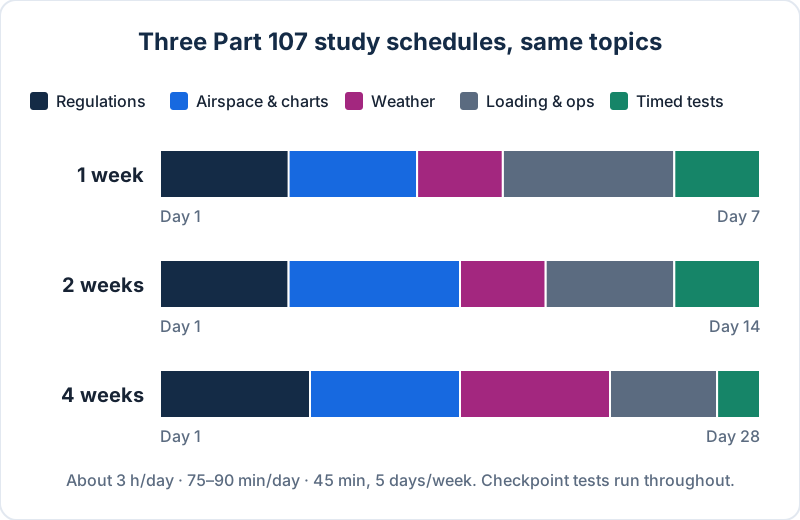 The same topics, stretched over different calendars. Every plan ends with timed practice tests.
Spacing matters more than people think. The 4-week plan has the fewest total hours, yet it often produces the steadiest scores, because you revisit material across weeks instead of seeing it once.
Your study materials (the core set is free from the FAA)
- FAA-CT-8080-2H testing supplement (PDF (opens in a new tab)). The book of figures the test refers to: sectional excerpts, METARs and TAFs, the load factor chart and more. As of November 2026, the FAA's supplements page (opens in a new tab) still lists the 2018 "H" edition as current. It's shared with other pilot tests, so ignore figures for airplanes and focus on charts, weather and loading.
- Remote Pilot Airman Certification Standards, FAA-S-ACS-10B (PDF (opens in a new tab)). The official list of what can be tested. Print the knowledge-element pages and tick them off as you go.
- 14 CFR Part 107 (eCFR (opens in a new tab)) and AC 107-2A (PDF (opens in a new tab)). The rule itself, plus the FAA's plain-language explanation with examples.
- FAA UAG sample questions (PDF (opens in a new tab)). Good for seeing the "Refer to FAA-CT-8080-2H, Figure X" style. It's an older set, so double-check any rule answer against current Part 107. PSI also offers a free sample test under "Exam Resources" on its FAA site.
- Remote Pilot Study Guide, FAA-G-8082-22 (PDF (opens in a new tab)). Useful for weather, charts and decision-making. It's dated 2016, before the 2021 changes to night flight, operations over people, Remote ID and recurrent training. Where it disagrees with the eCFR or AC 107-2A, the newer source wins.
One 2026 change affects how you use these. The FAA's October 2026 testing advisory (opens in a new tab) says the UAG now includes image-based questions taken from current sectional charts that aren't in the supplement. Study the supplement figures, but also practice on a recent sectional excerpt or two so an unfamiliar chart doesn't throw you.
1-week Part 107 study plan (about 3 hours a day)
This is for people with a clear week and some tolerance for long sessions. Split each day into two blocks of about 90 minutes with a real break between them.
| Day | Morning block | Afternoon block | Output by end of day |
|---|---|---|---|
| 1 | Skim the ACS. Part 107 operating limits, certification, recurrent training, registration | Remote ID, accident reporting, waivers, alcohol and drugs; FAA regulations overview | One-page numbers sheet (400 ft, 87 kt, 3 SM, 500/2,000 ft, 10 days, $500) |
| 2 | Operations over people (all four categories), moving vehicles, night operations | Airspace classes and authorization; airspace classifications | Airspace table from memory; category flashcards |
| 3 | Sectional chart legend in FAA-CT-8080-2H; sectional charts | 30+ chart questions: floors, ceilings, MSL-to-AGL math, obstacles | First full timed practice test, scored and logged |
| 4 | Weather theory: stability, fronts, fog, thunderstorms, density altitude | METAR and TAF decoding from every supplement weather figure; how to read a METAR | Plain-English decode of 10 METARs |
| 5 | Loading and performance: load factor chart, CG, weight | Airport ops, traffic patterns, CTAF, radio phraseology | Second timed test; error log sorted by topic |
| 6 | Crew resource management, ADM, hazardous attitudes, aeromedical, maintenance | Re-drill your three weakest topics from the error log | Third timed test |
| 7 | Light review of the numbers sheet and error log only | Fourth timed test on fresh questions | Decide: book the test, or switch to the 2-week plan |
Honest warning: one week is tight for someone who has never seen a sectional chart. If Day 3's practice test lands below 60%, extend rather than force it.
2-week Part 107 study plan (75–90 minutes a day)
The default for most people. One focused session a day, with checkpoints at the end of each week.
| Day | Focus | Output |
|---|---|---|
| 1 | Skim the ACS; Part 107 applicability, definitions, operating limits | Numbers sheet started |
| 2 | Certification, recurrent training, registration, Remote ID, waivers, reporting | One-page rules summary |
| 3 | Operations over people (Categories 1–4), moving vehicles, night operations | Flashcards for categories and lighting rules |
| 4 | Airspace classes, controlled-airspace authorization (LAANC, DroneZone), TFRs, special-use airspace | Airspace table from memory |
| 5 | Sectional chart legend in FAA-CT-8080-2H | Identify 20 symbols cold |
| 6 | Chart practice: floors, ceilings, MSL vs. AGL, obstacles, airport data; one current sectional excerpt | 25+ chart questions |
| 7 | Checkpoint: first full timed practice test | Score plus list of weak areas |
| 8 | Weather theory: stability, fronts, fog, density altitude, thunderstorms; aviation weather | Notes on effects on drone performance |
| 9 | METAR and TAF decoding | Decode every weather figure in the supplement |
| 10 | Loading and performance: load factor chart, CG | Work the load-factor examples |
| 11 | Airport operations, traffic patterns, CTAF, radio procedures | Pattern-leg sketch for a sample runway |
| 12 | CRM, ADM, hazardous attitudes, aeromedical, maintenance and preflight | Flashcards |
| 13 | Two timed practice tests; review every miss | Error log by topic |
| 14 | Targeted review of your weakest 2–3 topics; one last fresh timed test | Decide: book the test or add a week |
4-week Part 107 study plan (about 45 minutes, 5 days a week)
Built for evenings after work. Twenty sessions, with a timed test at the end of every week from Week 2 on.
| Week | Session 1 | Session 2 | Session 3 | Session 4 | Session 5 |
|---|---|---|---|---|---|
| 1: Regulations | ACS skim; applicability and definitions | Operating limits (altitude, speed, visibility, clouds) | Certification, recurrent training, registration, Remote ID | Operations over people and moving vehicles | Night ops, reporting, waivers, alcohol; short regulations quiz |
| 2: Airspace and charts | Airspace classes A–G | Authorization, LAANC, TFRs, special-use airspace | Sectional legend in the supplement | Chart practice: MSL/AGL math, obstacles | Timed practice test #1 (baseline) |
| 3: Weather and performance | Weather theory: stability, fronts, fog | Thunderstorms, density altitude, wind | METAR decoding | TAF decoding; redo missed chart questions | Timed test #2 |
| 4: Operations and review | Airport ops, traffic patterns, radio | CRM, ADM, hazardous attitudes, aeromedical | Loading: load factor, CG; maintenance and preflight | Timed test #3; review every miss | Timed tests #4 and #5 (weekend) |
If you can add one weekend session in Weeks 1 and 3, use it to revisit the previous week's flashcards. That spaced repetition is what makes the slower plan stick.
How to split your study time across Part 107 topics
The FAA's ACS and PSI's current bulletin give different topic weightings. PSI's 2025 numbers put regulations at 48% of the test, while the 2021 ACS gives regulations 15–25% and operations 35–45%. (The full comparison is in how hard the Part 107 exam is.) Since you can't be sure which split your test follows, this time split covers both:
| Topic | Share of study time | Why |
|---|---|---|
| Regulations, incl. operations over people | 30% | Largest share under PSI; the most-missed code is here |
| Airspace and sectional charts | 25% | Heavy on both lists; now includes on-screen chart images |
| Operations (airport ops, radio, ADM, CRM, aeromedical) | 20% | Largest share under the ACS |
| Weather and METAR/TAF | 15% | New vocabulary takes time even if it's fewer questions |
| Loading and performance | 10% | Small, but load factor and CG are quick points |
How to study the topics that cost the most points
Sectional charts
Work every chart question with the figure open. Find the area number, say out loud what you see ("dashed magenta, so Class E to the surface"), then look at the choices. Do the MSL-to-AGL subtraction on paper every time. If controlled vs. uncontrolled airspace is still fuzzy, start there before the chart drills.
METAR and TAF
Decode line by line in plain English until it's automatic. Wind is from true north, visibility is in statute miles, cloud heights are hundreds of feet AGL, and the altimeter is in inches of mercury. A TAF adds valid periods and change groups like FM, TEMPO and PROB30.
Operations over people
The FAA's frequently missed codes report (opens in a new tab) shows the UAG element on declarations of compliance was missed 78.58% of the time between July 2024 and June 2025. Make a four-row table, one row per category, with what each requires (weight or injury limits, declaration of compliance, airworthiness certificate, sustained flight rules). Rewrite it from memory until it's perfect.
Loading and performance
Learn to read the load factor chart and know the two anchor points: about 1.4 at a 45° bank and 2.0 at 60°. Know that higher density altitude means worse performance, and that CG outside limits hurts stability and control.
The study loop that actually works
Rereading feels productive and does little. Recalling does a lot. Each study session should end with questions, not more reading.
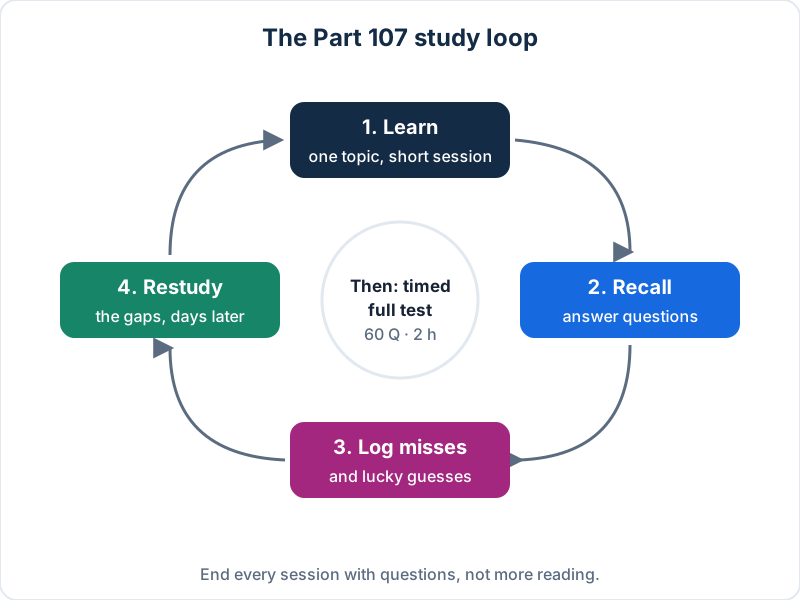 Short loops, repeated across days, beat one long cram session.
Keep an error log
Every miss, and every lucky guess, goes into a simple log:
| Topic / ACS area | What I picked | Correct answer | Why I missed it | Fix |
|---|---|---|---|---|
| Airspace (UA.II) | C, below 1,500 ft AGL | B, below 250 ft AGL | Read the MSL shelf floor as AGL | Always subtract field elevation |
| Weather (UA.III) | 6 nautical miles | 6 statute miles | Mixed up units | METAR visibility is SM |
After a week, sort the log by topic. The pattern tells you what to restudy far better than your gut does.
How to use Part 107 practice tests well
- Take a baseline early (Day 3 on the 1-week plan, Day 7 on the 2-week plan, end of Week 2 on the 4-week plan).
- Simulate the real thing: 60 questions, 2 hours, supplement open, no notes, phone in another room.
- Use fresh questions for readiness checks. Retaking the same set measures memory, not understanding.
- Review guessed-right answers too. A lucky guess is a miss you haven't paid for yet.
Our free Part 107 practice test is built for these timed runs. If you want a guided version of the plans above, with lessons, chart drills and progress tracking, that's what our Part 107 online course does.
Practice question: load factor
A small quadcopter weighing 10 lb makes a level, coordinated 45° banked turn. Using the load factor chart in FAA-CT-8080-2H (load factor about 1.41 at 45°), about how much load must its structure support?
A. 10 lb B. 14 lb C. 20 lb
Show answer
Answer: B. Load = weight × load factor: 10 × 1.41 ≈ 14 lb. C corresponds to a load factor of 2, which is a 60° bank. A ignores the extra load a banked turn adds.
When should you book the Part 107 test?
Book once you've scored comfortably above passing on two or three fresh, timed tests in a row. Many people book a date about a week out as a deadline, which is fine as long as you'll move it if your scores dip. PSI's bulletin says a cancellation or reschedule must be received at least 24 hours before your appointment, and a voicemail doesn't count. If you fail, the retest wait is 14 calendar days, so booking too early can cost you two weeks and a second fee.
Common Part 107 study mistakes
- Spending most of your time on rules you half-know. Regulations feel productive, but charts and weather are where unprepared people bleed points.
- Studying charts only from cropped app screenshots. Learn the supplement figures, plus at least one current sectional excerpt.
- Skimming operations over people. The FAA's own data says this is the most-missed topic.
- Memorizing answer letters. The FAA varies wording and order and keeps revising questions.
- Skipping full timed tests. Plenty of people know the material and still run short searching the supplement.
- Using pre-2021 material that predates night operations, operations over people and Remote ID on the UAG.
- Booking after one barely-passing practice score.
Frequently asked questions
How long does it take to study for the Part 107 exam?
Most people with no aviation background need two to four weeks, roughly 15 to 25 focused hours. Experienced hobby pilots often need one to three weeks, and student pilots about one week. These are teaching estimates, not FAA figures. The real measure is consistent, timed practice scores above passing on questions you haven't seen.
Can I pass Part 107 by studying for one week?
Yes, if you can give it about three hours a day and you're comfortable with technical material. The 1-week plan above packs in four timed practice tests. If your first one scores below about 60%, switch to the 2-week plan rather than forcing the date.
What should I study first for Part 107?
Start with regulations: operating limits, certification, registration, Remote ID and operations over people. They're the largest share of the test under PSI's current weighting, and they give context for everything else. Move to airspace and sectional charts next, then weather, loading and operations.
Is the FAA study guide enough to pass Part 107?
Not by itself. The FAA's Remote Pilot Study Guide dates from 2016, before the 2021 rule changes on night flight, operations over people, Remote ID and recurrent training. Pair it with the current eCFR, AC 107-2A, the ACS, the FAA-CT-8080-2H supplement and plenty of timed practice questions.
How many hours a day should I study for Part 107?
Between 45 minutes and three hours, depending on your plan. Shorter daily sessions spread across more days usually stick better than long cram sessions. Whatever you choose, end each session with practice questions rather than more reading, and log every miss so you can see your weak topics.
Do I need to memorize the testing supplement?
No. The test center gives you the supplement, so you need to know how to navigate it, not memorize it. Learn where the legend, chart figures and weather figures sit. Since October 26, 2026, some chart questions show images that aren't in the supplement, so practice reading unfamiliar sectional excerpts as well.
When am I ready to take the Part 107 test?
You're ready when you score comfortably above 70% on two or three fresh, timed, full-length practice tests in a row, answer chart and weather questions without guessing, and finish with time to spare. One good score isn't enough. Look for a consistent pattern with margin.
Sources
- FAA — Airman Knowledge Testing Supplements (FAA-CT-8080-2H listed as current; page updated 9/29/2026)
- FAA — FAA-CT-8080-2H Airman Knowledge Testing Supplement for Sport Pilot, Recreational Pilot, Remote Pilot, and Private Pilot (PDF)
- FAA — Remote Pilot Small UAS Airman Certification Standards (FAA-S-ACS-10B)
- FAA — UAG Sample Airman Knowledge Test Questions (PDF)
- FAA — Advisory Circular 107-2A, Small Unmanned Aircraft System (Small UAS)
- FAA — Remote Pilot Small UAS Study Guide, FAA-G-8082-22 (2016)
- FAA — Airman Testing Community Advisory, October 2026 (UAG image-based questions from Oct 26, 2026)
- FAA — Frequently Missed Knowledge Test ACS Codes, 2nd Quarter CY25
- eCFR — 14 CFR Part 107
- PSI — UAG Applicant Information Bulletin, effective September 29, 2025 (topic weights; 24-hour cancellation rule; sample test under Exam Resources). Not linked in body.