
How to Get a Part 107 License (FAA Drone License), Step by Step
To get a Part 107 license, be at least 16, create an IACRA profile for an FAA Tracking Number, pass the 60-question UAG knowledge test at an FAA-approved testing center (about $175), then apply on Form 8710-13 in IACRA. After the TSA check you print a temporary certificate and can fly commercially.
To get a Part 107 license, you must be at least 16, pass the FAA's 60-question UAG knowledge test, and apply through IACRA. Testing centers charge about $175. The certificate itself is free.
The official name is a Remote Pilot Certificate with a small UAS rating, and the sequence never changes: create an IACRA profile to get your FAA Tracking Number (FTN), book and pass the Unmanned Aircraft General – Small (UAG) test, file FAA Form 8710-13 in IACRA, clear a TSA background check, then print a temporary certificate and start flying. If you already hold a Part 61 pilot certificate with a current flight review, a free online course replaces the test.
The exam gets all the attention, but the paperwork around it is where people lose weeks. This guide covers each step, the details that slow applications down, and what changed at testing centers in late 2026.
Key takeaways
- Eligibility: 16 or older to hold the certificate (you can take the test at 14), English proficiency, and no known condition that would make flying unsafe. There's no medical exam.
- Order matters: FTN in IACRA first, then the UAG test, then Form 8710-13. Doing it out of order is the most common self-inflicted delay.
- The test: 60 scored questions, 2 hours, 70% to pass. Since October 26, 2026, some questions include on-screen sectional chart images that aren't in the printed supplement.
- Cost: about $175 for the test, paid to the testing vendor. The FAA charges nothing for the certificate.
- Flying starts with the temporary certificate, not the passed test. It's valid for up to 120 days while the permanent card is mailed.
- It never expires, but you must complete free online recurrent training every 24 calendar months to keep using it.
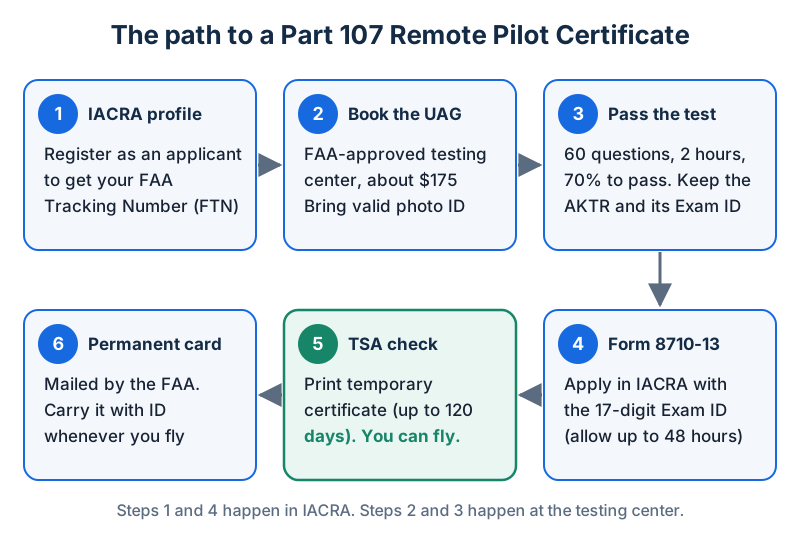 The standard path to a Part 107 Remote Pilot Certificate. Steps 1 and 4 happen in IACRA, steps 2 and 3 at the testing center.
What are the Part 107 requirements to become a drone pilot?
The eligibility rules are in 14 CFR 107.61 (opens in a new tab). You must:
- Be at least 16 years old. The FAA testing matrix lists a minimum age of 14 to take the UAG, but the certificate can't be issued until you turn 16.
- Be able to read, speak, write, and understand English. If a medical reason prevents one of these, the FAA may issue the certificate with operating limitations.
- Not know, or have reason to know, of a physical or mental condition that would interfere with safe drone operation. Part 107 has no FAA medical certificate. This is an honest self-assessment.
- Demonstrate aeronautical knowledge, either by passing the UAG test or, for current Part 61 pilots, by completing the FAA's online initial training.
A few things are not required, and people ask about all of them: you don't need to own a drone, hold a driver's license, attend a flight school, log any flight time, or be a U.S. citizen. You do need acceptable ID at the testing center.
One eligibility trap worth knowing: under §§107.57 and 107.59, a drug or alcohol offense, or refusing an alcohol test when a law enforcement officer requests one, can be grounds for the FAA to deny your application for up to a year.
Do you need a Part 107 license at all?
You need the certificate whenever a flight isn't purely recreational: real estate photos, roof inspections, wedding video, YouTube footage you monetize, even helping a friend's business for free. If you only ever fly for fun, the recreational exception may cover you instead, with the free TRUST test. The line between the two is covered in Part 107 vs. recreational flying, and the free lesson on what Part 107 is explains the rule set itself.
Step 1: Create an IACRA profile and get your FTN
Before you book anything, register as an applicant in IACRA (opens in a new tab), the FAA's Integrated Airman Certification and Rating Application. Registration generates your FAA Tracking Number (FTN). The FAA testing matrix (opens in a new tab) tells applicants who don't have an FTN to create one before taking a knowledge test, because the FTN is printed on your score report and ties the result to your certificate application.
Three setup details save headaches:
- Use your legal name exactly as it appears on your ID. Same spelling, same middle name or initial, same suffix.
- Use an email address you'll keep. The FAA sends the TSA clearance and temporary-certificate instructions there.
- Record your username and FTN somewhere you'll find them in two years.
Step 2: Book the UAG test at an FAA-approved testing center
The FAA's knowledge tests are administered by its testing vendor, PSI, at approved testing centers. You book on PSI's FAA site (faa.psiexams.com, linked from the FAA's own pilot page), choose Unmanned Aircraft General – Small (UAG), pick a center, date, and time, and pay when you book. The FAA's cost FAQ (opens in a new tab) says testing centers charge approximately $175. The full breakdown, including retakes, is in how much the Part 107 exam costs.
Rules from PSI's current UAG bulletin worth knowing before you book:
- Rescheduling or cancelling requires notice received at least 24 hours before your exam time. A voicemail doesn't count.
- Arrive at least 15 minutes early. If you arrive late, you may not be admitted and may forfeit the fee.
- Accommodations for a disability are requested during scheduling, on the screen after you pick the test.
- No instructor endorsement is required to take the UAG, and none is required to retake it.
A heads-up for early 2027: the FAA's October 2026 testing advisory says the knowledge testing program will move to PSI's next-generation scheduling and check-in platform in the first quarter of 2027. PSI says it will contact applicants directly if the change affects an existing appointment, so keep an eye on your email if you book for January through March.
What ID to bring
Your ID must be valid and current and show your photo, date of birth, signature, and physical residential address. The information can come from more than one document.
| You are | Acceptable ID (per the FAA testing matrix) |
|---|---|
| U.S. citizen or resident alien | State or territory driver's license or ID card, U.S. government or military ID, passport, or alien residency card |
| Non-U.S. citizen | Passport and a U.S. driver's license or a government-issued ID card |
| Under 18 with no acceptable ID | A parent or legal guardian comes with you, shows their own ID, and attests to your identity |
If your ID doesn't show your residential address (a passport, for example), bring an accepted proof of address such as a utility bill, signed lease, mortgage statement, or voter registration card. A P.O. box, a business address, and a cable bill don't count. Showing up without proper ID is treated as a missed appointment.
Step 3: Pass the Unmanned Aircraft General – Small (UAG) test
The UAG has 60 scored multiple-choice questions, a 2-hour limit, and a 70% passing score, so you need 42 correct. PSI's bulletin adds that 5 unscored validation questions are mixed in, and the 2 hours covers them. You can't tell which ones they are, so answer everything. The questions span regulations, airspace, weather, loading and performance, and operations (radio procedures, airport operations, emergencies, crew resource management, decision-making, physiology, maintenance, and night flying). The Part 107 study guide breaks the topics down, and how hard the Part 107 exam is covers scoring and difficulty.
What changed in October 2026
The FAA's October 2026 Airman Testing Community Advisory (opens in a new tab) says that as of October 26, 2026, the UAG began featuring image-based questions not included in the testing supplement, using images from current FAA sectional charts. The printed supplement (FAA-CT-8080-2H) is still provided at the center, and the FAA says it will give "ample notice" before supplements are removed. No removal date has been set.
What that means for you: memorizing the supplement's figures is no longer enough. You need to read an unfamiliar sectional excerpt cold, find the airspace, the altitudes, and the obstacles. If charts are your weak spot, work through the sectional charts guide and the airspace classifications guide with real, current charts.
Your test report
When you finish, the proctor hands you an Airman Knowledge Test Report (AKTR). It shows your score, your FTN, the 17-digit Exam ID you'll need in Step 4, and the ACS codes for any questions you missed. Keep the original. If you lose it, you can reprint it from your PSI account. A passing AKTR stays valid for 24 calendar months for applying for the certificate, according to the Remote Pilot ACS.
If you don't pass, 14 CFR 107.71 (opens in a new tab) makes you wait 14 calendar days before retesting. Bring the failed AKTR; the proctor scans it and destroys it. Use the missed ACS codes to target what you restudy.
Step 4: Complete FAA Form 8710-13 in IACRA
Log back into IACRA and follow the FAA's published sequence:
- Click Start New Application.
- Application Type: Pilot.
- Certifications: Remote Pilot.
- Select Other Path Information, then Start Application.
- Follow the prompts. When asked, enter the 17-digit Knowledge Test Exam ID from your AKTR.
- Sign electronically and submit.
The FAA notes that it can take up to 48 hours from the test date for your result to appear in IACRA. If IACRA rejects your Exam ID the afternoon of your test, that's normal. Wait two days before you contact anyone.
Before you sign, compare three things side by side: the name on your ID, the name in IACRA, and the name on the AKTR. A mismatch here is the single most common reason a clean pass turns into a stuck application.
Step 5: Clear the TSA check and print your temporary certificate
After you submit, your application goes through a TSA security background check. When it clears, the FAA sends a confirmation email with instructions for printing your temporary Remote Pilot Certificate from IACRA.
That printout is a real certificate. Under 14 CFR 107.64, it's issued for up to 120 calendar days and lets you exercise Part 107 privileges immediately. It ends on its expiration date, when your permanent certificate arrives, or if the FAA tells you the certificate is denied. The FAA publishes no processing time for the TSA check, so don't promise a client a date based on someone else's experience.
Step 6: Receive your permanent certificate and carry it when you fly
The FAA mails the permanent certificate once its internal processing is complete. Under 14 CFR 107.7, whenever you fly under Part 107 you must have the certificate and an ID in your physical possession and readily accessible, and you must show them on request to the FAA, the NTSB, the TSA, or any federal, state, or local law enforcement officer.
The certificate covers you. Your drone has its own paperwork: every drone you fly under Part 107 must be registered for Part 107 in FAADroneZone (opens in a new tab) at $5 per drone for three years, marked with its registration number, and compliant with Remote ID. A drone registered under the recreational exception can't be flown under Part 107.
How long does Part 107 certification take?
The FAA guarantees no end-to-end timeline. Here's which stages you control and which you don't.
| Stage | What drives the time | Typical range |
|---|---|---|
| Studying | Your background and weekly hours | A few days to several weeks (Part 107 study plan) |
| Getting a test slot | Testing center availability near you | Same week to a few weeks, depending on location |
| Test result appears in IACRA | FAA data transfer | Up to 48 hours (FAA-stated) |
| TSA check and temporary certificate | Background check queue | Often days to a couple of weeks; not guaranteed |
| Permanent card | FAA processing and mail | Several weeks; the temporary certificate covers you meanwhile |
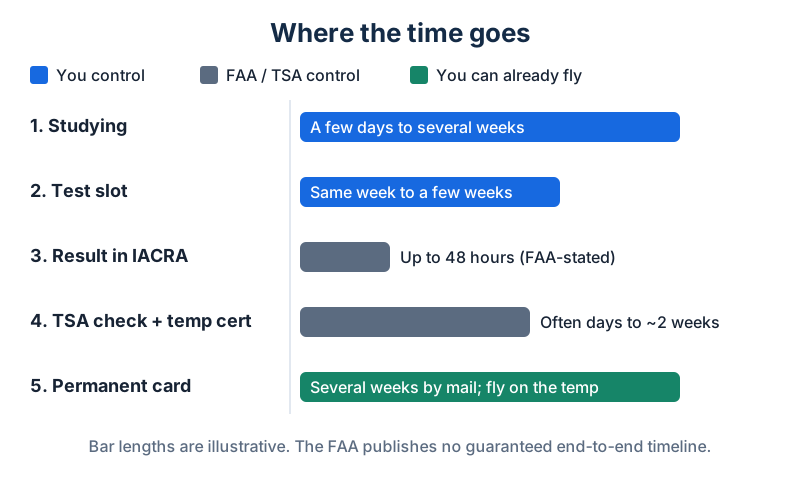 Where the time goes. Ranges are general expectations, not FAA commitments.
Worked example: working backward from a job date
Say a roofing company wants you flying inspections on March 2. Work backward:
- Leave two to three weeks for the TSA check and temporary certificate. That puts your application around February 9.
- Add the 48-hour IACRA window, so a test around February 6.
- Build in a failed attempt. If you fail on February 6, the earliest retest is February 20, which pushes your application to the 22nd and leaves you about a week for processing. Tight, but possible.
- So book the first attempt in late January, and start studying in early January.
That buffer feels excessive until the one time you need it.
The path for existing Part 61 pilot certificate holders
If you hold a pilot certificate issued under Part 61 (anything other than a student pilot certificate) and have completed a flight review within the previous 24 calendar months, you skip the testing center:
- Log into FAASafety.gov (opens in a new tab) and complete the free Part 107 Small UAS Initial (ALC-451) course.
- Complete Form 8710-13 for a remote pilot certificate in IACRA, using the same Pilot, Remote Pilot, Other Path Information sequence.
- Make an appointment to have your identity validated with an FAA Flight Standards District Office (FSDO), a designated pilot examiner (DPE), an airman certification representative (ACR), or a certificated flight instructor (CFI).
- Bring your completed 8710-13, proof of your current flight review, photo ID, and your ALC-451 completion certificate.
- The FSDO, DPE, or ACR signs your application and issues a temporary certificate. A CFI can process the application but can't issue a temporary certificate. The FAA says the permanent certificate arrives by mail within several weeks.
If your flight review has lapsed, complete one first or take the UAG.
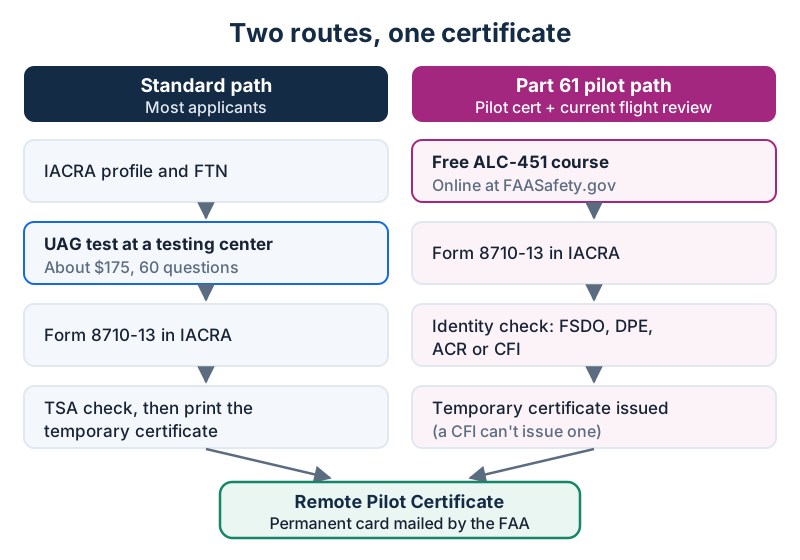 Two routes to the same certificate. The Part 61 route requires a current flight review.
Common mistakes that delay your Part 107 license
- Booking the test before you have an FTN. Get the FTN first so it prints on your AKTR.
- Name mismatches. "Jon" in IACRA, "Jonathan" on your license, and a middle initial on the AKTR can each stall an application.
- Panicking when IACRA doesn't find your Exam ID on test day. Give it 48 hours.
- Flying paid work after passing but before the temporary certificate. The pass isn't the certificate.
- Studying only from the testing supplement. Since October 26, 2026, some chart questions use images that aren't in it.
- Registering a work drone as recreational. That registration doesn't cover Part 107 flights.
- Forgetting recurrent training. The certificate doesn't expire, but your privileges lapse after 24 calendar months without training. See Part 107 recurrent training.
Your Part 107 checklist
Use this as a single pass through the whole process:
- Confirm you're 16 (or will be by the time you apply) and meet the English requirement
- Create an IACRA profile and record your FTN
- Gather valid ID showing photo, date of birth, signature, and residential address
- Study, then take a timed full-length practice exam
- Book the UAG with PSI, noting the 24-hour reschedule rule
- Take the test and keep (and photograph) the AKTR
- Wait up to 48 hours, then file Form 8710-13 in IACRA with your 17-digit Exam ID
- Watch your email for TSA clearance and print the temporary certificate
- Register each work drone for Part 107 and confirm Remote ID compliance
- Put your recurrent training deadline (end of the month, 24 months out) in your calendar
Practice question
Question: A 15-year-old passes the UAG knowledge test. When can they be issued a Remote Pilot Certificate?
A. Immediately, because the minimum age to take the test is 14. B. Once they turn 16 and apply through IACRA. C. Only after they turn 18.
Show answer
Answer: B. The FAA testing matrix allows the UAG to be taken at 14, but 14 CFR 107.61(a) requires an applicant to be at least 16 to be issued the certificate. Because a passing AKTR is valid for 24 calendar months for applying, a test taken at 15 can still be used at 16, as long as the report hasn't run out.
Frequently asked questions
How long does it take to get a Part 107 license?
Most of the time is studying and waiting for a test slot, which you control. After the test, results can take up to 48 hours to reach IACRA, and the TSA check that releases your temporary certificate has no published processing time. Many applicants see it in days to a couple of weeks, but plan for longer if a job depends on it. The permanent card follows by mail, and the temporary certificate covers you meanwhile.
Can I fly commercially as soon as I pass the test?
No. Passing the UAG makes you eligible to apply, not certificated. You still have to submit Form 8710-13 in IACRA and clear the TSA background check. Once the FAA emails you, print the temporary Remote Pilot Certificate from IACRA. From that point you can fly under Part 107, as long as your drone is registered for Part 107 and the flight complies with the rules.
Is a Part 107 license the same as an FAA drone license?
Yes. "FAA drone license" and "Part 107 license" are informal names for the same credential: a Remote Pilot Certificate with a small UAS rating, issued under 14 CFR Part 107. The FAA doesn't use the word "license" for it. Recreational flyers take the TRUST test instead, which produces a completion certificate, not a pilot certificate, and doesn't allow commercial work.
Do I need to be a U.S. citizen to get a Part 107 certificate?
No. Part 107 doesn't require U.S. citizenship or residency. Non-U.S. citizens test with a passport plus a U.S. driver's license or another government-issued ID showing a residential address. Drone registration is different: the FAA registers drones for U.S. citizens and legal permanent residents, and treats registrations by foreign operators as a recognition of ownership instead.
How much does it cost to get a Part 107 license?
The FAA says testing centers charge approximately $175 for the initial UAG knowledge test, paid to the testing vendor when you book. The FAA charges nothing to process your application or issue the certificate, and recurrent training is free online. Registering each drone for Part 107 costs $5 for three years. Study materials range from free FAA publications to paid courses.
Does a Part 107 license expire?
The certificate itself never expires. What lapses is your currency: under 14 CFR 107.65, you can fly under Part 107 only if you've passed the initial test or completed recurrent training within the previous 24 calendar months. Recurrent training is a free online course on FAASafety.gov, ALC-677 for most pilots, and it restores currency without a trip to a testing center.
What happens if I fail the Part 107 test?
You wait 14 calendar days, then book and pay for another attempt. No instructor endorsement is needed. Bring your failed AKTR to the testing center, where the proctor scans and destroys it. Before retesting, look up each ACS code printed on the report in the Remote Pilot ACS. Those codes point to the exact knowledge areas you missed.
Next steps
If you're starting from zero, read the Part 107 study guide to see the scope, then take a timed run of the free Part 107 practice test before you book a slot. If you want a structured route through every ACS area, the DroneExamReady Part 107 course is built around the same topics, with practice questions in each module.
Sources
- FAA — Become a Certificated Remote Pilot (last updated June 9, 2026)
- eCFR — 14 CFR Part 107, Subpart C (Remote Pilot Certification)
- FAA — Airman Knowledge Testing Matrix (revised September 25, 2026)
- FAA — Airman Testing Community Advisory, October 2026 edition
- FAA — How much does it cost to get a remote pilot certificate? (FAQ)
- FAA — Integrated Airman Certification and Rating Application (IACRA)
- FAA — Remote Pilot Small UAS Airman Certification Standards (FAA-S-ACS-10B)
- FAASTeam — ALC-451 Part 107 Small UAS Initial (Part 61 Pilots)
- FAA — How to Register Your Drone
- PSI — Unmanned Aircraft General – Small Applicant Information Bulletin (effective September 29, 2025)