
Part 107 Rules: The FAA Drone Regulations Most Tested
Part 107 is the FAA rule for non-recreational drones under 55 lb. The most tested rules are the §107.51 limits (400 ft AGL, 87 knots, 3 SM visibility, 500 ft below and 2,000 ft horizontally from clouds), visual line of sight, night and twilight lighting, operations over people, 10-day safety event reporting, waivers, and 24-month recency.
Part 107 rules are the FAA regulations for non-recreational drones under 55 lb: a remote pilot certificate, 400 ft AGL, visual line of sight, 87 knots, and 3 miles visibility. They live in 14 CFR Part 107 and cover any flight that isn't purely recreational, paid or not. On the knowledge test, the questions cluster around a short list: the §107.51 limits, visual line of sight, night and twilight lighting, operations over people, the 10-day safety event report, what a waiver can and can't cover, and the 24-month recency rule.
The rules themselves aren't hard. What catches people is that the exam asks about the exceptions and edge cases. This page gives you the numbers, then the traps.
Key takeaways
- The four §107.51 limits: 87 knots (100 mph), 400 ft AGL (or within 400 ft of a structure), 3 statute miles visibility, and 500 ft below / 2,000 ft horizontally from clouds.
- Visual line of sight means unaided eyes. Corrective lenses are the only device allowed.
- Civil twilight and night both require anti-collision lights visible for 3 statute miles. Night also requires that your test or training was completed after April 6, 2021.
- Report within 10 calendar days if anyone is seriously injured or loses consciousness, or if property other than the drone suffers more than $500 of damage.
- Only the sections listed in §107.205 can be waived. Alcohol, hazmat and reporting are not on the list.
- Your certificate doesn't expire, but acting as RPIC requires the test or recurrent training within the previous 24 calendar months.
Who Part 107 applies to (and who it doesn't)
Part 107 covers registration, airman certification and operation of civil small unmanned aircraft systems in the United States (§107.1). A small unmanned aircraft weighs less than 55 lb at takeoff, including everything on board or attached.
It does not apply to:
- recreational flying under 49 U.S.C. 44809 (the TRUST certificate path),
- air carrier operations,
- operations a holder chooses to conduct under a Section 44807 or 333 exemption, and
- drones with an airworthiness certificate flown under Part 91.
The test is purpose, not money: free photos for a friend's real estate listing or a roof inspection for your own business are not recreational. For the gray areas, see the Part 107 vs. recreational comparison. If you're brand new, start with the free lesson on what Part 107 is.
Part 107 rules at a glance: the numbers to memorize
This is the table I'd put on a flashcard.
| Rule | Number | Section |
|---|---|---|
| Small UA weight | Less than 55 lb at takeoff | §107.3 |
| Max groundspeed | 87 knots (100 mph) | §107.51(a) |
| Max altitude | 400 ft AGL, or within a 400-ft radius of a structure and no more than 400 ft above its top | §107.51(b) |
| Min flight visibility | 3 statute miles from the control station | §107.51(c) |
| Cloud clearance | 500 ft below, 2,000 ft horizontally | §107.51(d) |
| Anti-collision lighting | Visible 3 SM (night and civil twilight) | §107.29 |
| Civil twilight (outside Alaska) | 30 min before sunrise; 30 min after sunset | §107.29(c) |
| Safety event report | Within 10 calendar days | §107.9 |
| Property damage threshold | More than $500 | §107.9(b) |
| Alcohol | 8 hours bottle to throttle; under 0.04 | §107.27 → §91.17 |
| Minimum age for certificate | 16 | §107.61 |
| Knowledge recency | 24 calendar months | §107.65 |
| Registration fee / term | $5 per aircraft / 3 years | §§48.30, 48.100 |
Before you fly: certificate, registration, and Remote ID
Remote pilot certificate and recency
To act as remote pilot in command (RPIC), or to manipulate the controls on your own, you need a remote pilot certificate with a small UAS rating (§107.12). Under §107.61 you must be at least 16, able to read, speak, write and understand English, free of any known disqualifying condition, and have passed the initial knowledge test (Part 61 pilots with a current flight review take §107.74 training instead). A temporary certificate lasts up to 120 days. The application steps are in the guide to getting your Part 107 license.
Someone without a certificate can fly the drone only under the direct supervision of an RPIC who can immediately take direct control.
The certificate never expires. What lapses is recency: under §107.65 you need to have passed the initial test or completed recurrent training within the previous 24 calendar months. Calendar months matter. If you passed on March 3, 2025, you're current through March 31, 2027. The recurrent training guide covers the free online course.
Carry your certificate and ID when flying, and show them on request to the FAA, NTSB, TSA or any law enforcement officer (§107.7). And if you move, tell the FAA within 30 days (§107.77).
Registration under Part 48
Every drone flown under Part 107 must be registered, whatever its weight. The 0.55-lb exception in §48.15 applies only to recreational flying under 44809. The fee is $5 per aircraft (§48.30), registration lasts 3 years, and you must update your information within 14 calendar days of a change, such as a new address or a sold drone (§48.115). The registration number goes on an external surface of the aircraft (14 CFR Part 48 (opens in a new tab)).
Remote ID under Part 89
Since September 16, 2023, Part 89 (opens in a new tab) requires one of three things for almost every drone flight:
- A standard Remote ID drone, broadcasting from takeoff to shutdown.
- A broadcast module attached to an older drone, which you must keep within visual line of sight.
- Flying at an FAA-Recognized Identification Area (FRIA).
If the broadcast fails in flight, land as soon as practicable. The serial number of the Remote ID drone or module must be on your registration. See the FAA's Remote ID page (opens in a new tab).

Part 107 operating limitations (§107.51)
§107.51 (opens in a new tab) holds most of the numbers in the rule. It applies to both the RPIC and the person on the sticks, in every class of airspace.
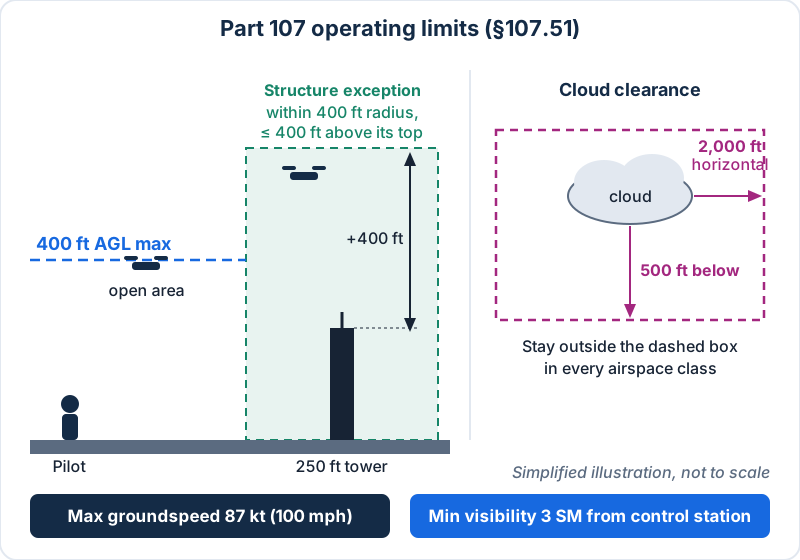
The four §107.51 limits. Simplified illustration, not to scale.
Altitude: 400 ft AGL and the structure exception
The default ceiling is 400 ft above ground level. You may go higher only if the drone is within a 400-ft radius of a structure and no more than 400 ft above the structure's immediate uppermost limit.
Worked example: you're inspecting a 250-ft cell tower. You can climb to 650 ft AGL, as long as you stay within 400 ft of the tower horizontally. Drift 450 ft away and your ceiling drops back to 400 ft AGL. The exception follows the structure. It isn't a new ceiling for the whole area.
The exception doesn't waive airspace rules: a tower inside Class D still needs ATC authorization. And a mountain isn't a structure; AGL already follows the ground.
Speed, visibility, and cloud clearance
- Groundspeed: 87 knots (100 mph). Note it's groundspeed, so a tailwind counts.
- Flight visibility: at least 3 statute miles, measured from the control station, not from the drone.
- Clouds: at least 500 ft below and 2,000 ft horizontally from any cloud.
These numbers are the same in Class G and Class B. Manned pilots often reach for the class-by-class §91.155 table. For Part 107, ignore it. The airspace classifications lesson explains why the class matters for authorization but not for weather minimums.
Worked example: checking a weather report against §107.51
Say the nearest report reads SCT008 OVC015 with 2SM BR. Can you fly?
- Visibility is 2 SM. That's below 3 SM. Stop here: no flight without a waiver.
- Suppose visibility improves to 5 SM but the scattered layer stays at 800 ft AGL. Your ceiling becomes 800 − 500 = 300 ft AGL, because you must stay 500 ft below the clouds.
The exam loves step 2: the right answer is lower than 400. If decoding the report is the hard part, work through the METAR decoding lesson first.
Visual line of sight, visual observers, and one drone at a time
Under §107.31, the RPIC and the person manipulating the controls must be able to see the drone throughout the flight, with vision unaided by any device other than corrective lenses. You need to know its location, attitude, altitude and direction, and watch for traffic and hazards.
A visual observer (VO) can provide that capability instead, under §107.33. If you use one, the RPIC, the person on the controls and the VO must keep effective communication at all times.
Three exam points live here:
- Binoculars don't extend VLOS. AC 107-2A allows vision aids only momentarily for situational awareness.
- FPV goggles don't satisfy VLOS. If the pilot wears goggles, a VO must keep unaided eyes on the drone.
- One drone per person (§107.35). You can't act as RPIC, pilot or VO for more than one unmanned aircraft at the same time without a waiver.
Night and civil twilight rules (§107.29)
Night flights don't need a waiver, but they need two things:
- The RPIC must have completed the initial knowledge test or training after April 6, 2021. If you were certificated earlier, the updated recurrent training satisfies this.
- The drone must have lighted anti-collision lighting visible for at least 3 statute miles, with a flash rate sufficient to avoid a collision.
Civil twilight requires the same anti-collision lighting. Outside Alaska, it's the 30 minutes before official sunrise and the 30 minutes after official sunset. Alaska uses the Air Almanac definition. You may dim the lights for safety. You may never turn them off.
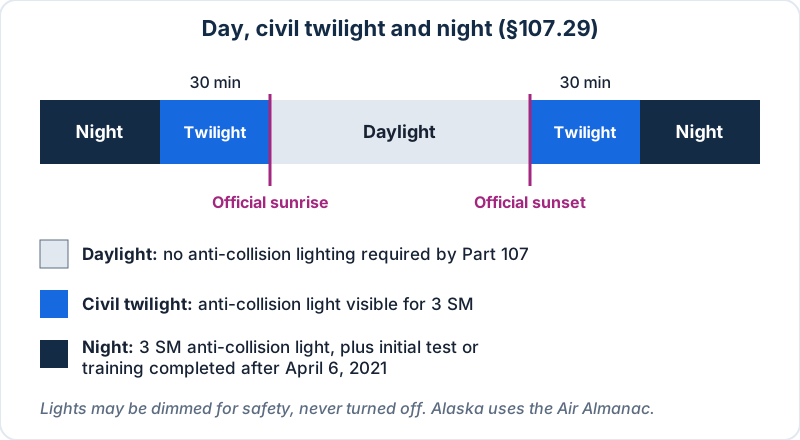
When §107.29 lighting applies. Simplified illustration.
A classic trap: sunset is 7:42 p.m., and the question asks whether lights are needed at 8:05 p.m. They are. That's civil twilight, and the rule applies even though it's "not night yet."
Night flying also changes your preflight. In controlled airspace you still need an airspace authorization, and a weather picture that looked fine at 4 p.m. can bring fog or low clouds after dark.
Flying over people and moving vehicles
The base rule (§107.39)
You may fly over a person only if that person is directly participating in the operation, is under a covered structure or inside a stationary vehicle that offers reasonable protection, or the flight meets one of the four Subpart D categories. A crew member holding a reflector counts as participating. A bystander walking a dog doesn't.
The four categories
| Category | What qualifies the drone | Key operating limits |
|---|---|---|
| 1 | 0.55 lb or less, including attachments; no lacerating exposed rotating parts | No sustained flight over open-air assemblies unless Remote ID compliant |
| 2 | Declaration of compliance; injury below an 11 ft-lb impact; labeled | Same as Category 1 |
| 3 | Declaration of compliance; injury below a 25 ft-lb impact; labeled | No open-air assemblies. Closed- or restricted-access site with everyone on notice, or no sustained flight over non-participants |
| 4 | Airworthiness certificate under Part 21 | Same as Category 1; flight manual and maintenance limits |
The FAA's operations over people overview (opens in a new tab) is a good plain-language companion. On the exam, Category 3 is the one with the extra restrictions, and Category 1 is the only one with a weight limit.
Moving vehicles (§107.145)
Over people in moving vehicles, Categories 1 to 3 must either stay over a closed- or restricted-access site where everyone is on notice, or not maintain sustained flight over the vehicles. Category 4 follows its flight manual.
Prohibited and hazardous operations
- Careless or reckless operation that endangers life or property is prohibited (§107.23). So is dropping an object in a way that creates an undue hazard. Dropping something safely isn't banned.
- Alcohol and drugs (§107.27 → §91.17): no flying within 8 hours of any alcoholic drink, while under the influence, with an alcohol concentration of 0.04 or greater, or while using a drug that affects your faculties. It covers the RPIC, the person at the controls and the VO. Eight hours is a minimum, not a guarantee.
- Moving vehicles and aircraft (§107.25): never from a moving aircraft. From a moving land or water vehicle only over a sparsely populated area, and not while carrying someone else's property for hire.
- Hazardous materials (§107.36): never.
- Medical condition (§107.17): if you know or have reason to know a condition would interfere with safe operation, you can't fly or serve as a VO.
- Preflight (§§107.15, 107.49): inspect the aircraft before each flight, assess weather, airspace and ground hazards, and brief participants.
- In-flight emergencies (§107.21): you may deviate from any Part 107 rule to the extent needed. You send a written report only if the FAA asks for one.
Airspace and right-of-way rules
These short rules drive a lot of chart questions:
- §107.41: prior ATC authorization for Class B, C, D, and the surface area of Class E designated for an airport.
- §107.43: don't interfere with operations and traffic patterns at any airport, heliport or seaplane base.
- §107.45: permission from the using or controlling agency for prohibited or restricted areas.
- §107.47: comply with TFRs.
- §107.37: yield the right of way to all aircraft, airborne vehicles and launch and reentry vehicles. Don't pass over, under or ahead of them unless well clear.
- §§107.52–107.53: no transponder and no ADS-B Out unless the FAA authorizes it.
Class-by-class detail and LAANC are in the Part 107 airspace classifications guide.
Safety event reporting: the 10-day rule (§107.9)
Older materials call this "accident reporting"; the eCFR now says safety event reporting. Under §107.9 (opens in a new tab), the RPIC must report to the FAA no later than 10 calendar days after an operation involving:
- serious injury to any person, or any loss of consciousness; or
- damage to any property other than the drone, unless the repair cost (materials and labor) is $500 or less, or the fair market value is $500 or less if it's a total loss.
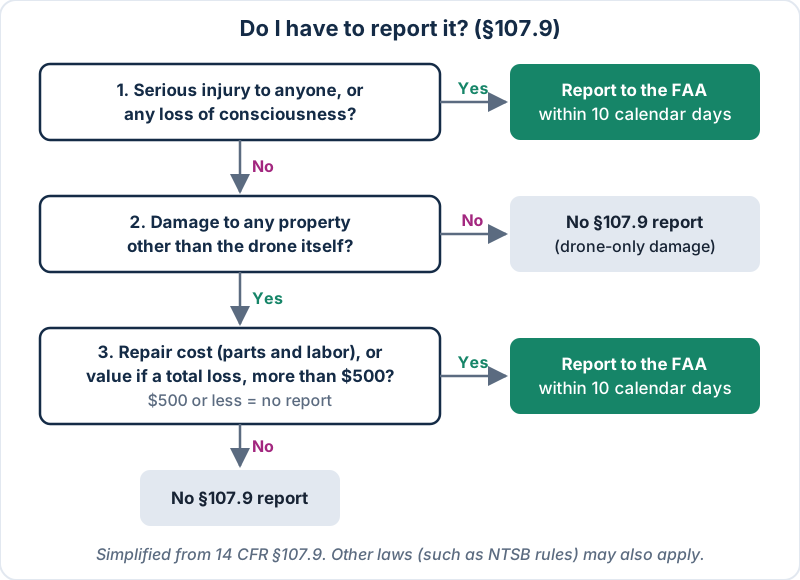
Working through §107.9. Simplified illustration.
Worked scenarios
- You crash a $2,000 drone into an empty field. No report. Damage to the drone itself never counts.
- The drone clips a parked car. The body shop quotes $640. Report within 10 days. It's over $500.
- The drone destroys an old fence panel worth $300. A new one would cost $650. The panel is a total loss, so you look at its fair market value, and $300 is under the threshold. No report. This is the "whichever is lower" logic in AC 107-2A, and it's the one people miss.
- A spectator faints when the drone buzzes past. Report. Any loss of consciousness counts, even without a collision.
Part 107 waivers: what can and can't be waived
A certificate of waiver (§107.200) lets you deviate from specific rules if you show the FAA the operation can be done safely. Only the sections in §107.205 (opens in a new tab) are eligible:
- Waivable: §107.25 moving vehicle or aircraft; §107.29(a)(2) and (b) anti-collision lighting; §107.31 visual line of sight; §107.33 visual observer; §107.35 multiple aircraft; §107.37(a) right of way; §107.39 over people; §107.41 certain airspace; §107.51 operating limits; §107.145 over moving vehicles. Neither §107.25 nor §107.31 can be waived to carry another person's property for hire.
- Not waivable (not on the list): reporting (§107.9), the certificate requirement (§107.12), careless or reckless operation (§107.23), alcohol or drugs (§107.27), hazmat (§107.36), airport interference (§107.43), prohibited or restricted areas (§107.45) and TFRs (§107.47).
Notice the night trap. The night training requirement in §107.29(a)(1) isn't on the list. Only the lighting can be waived.
Waiver applications now go through the FAA's Aviation Integrated Safety (AIS) Services system, according to the FAA's Part 107 waivers page (opens in a new tab). Airspace authorizations are different: they come through LAANC or FAADroneZone and let you into controlled airspace under the normal rules, while a waiver changes the rules. Beyond-visual-line-of-sight flights still need a §107.31 waiver for now. The proposed Part 108 BVLOS rule hasn't been finalized.
Common Part 107 exam traps
- "The certificate expires every two years." It doesn't. Recency lapses after 24 calendar months.
- Forgetting twilight. Lights are required in civil twilight, not just at night.
- Treating "controlled airspace" as "authorization required." Class E above 700 or 1,200 ft AGL doesn't trigger §107.41.
- Using the structure exception away from the structure. It's a 400-ft radius, not a new ceiling.
Practice question: the structure exception
Try one. You're inspecting a 300-ft antenna. What is the maximum altitude while within 400 ft of it?
- A. 400 ft AGL
- B. 700 ft AGL
- C. 800 ft AGL
Show answer
B. §107.51(b) allows up to 400 ft above the structure's uppermost limit within a 400-ft radius: 300 + 400 = 700 ft AGL.
Frequently asked questions
What is the Part 107 altitude limit?
The Part 107 altitude limit is 400 feet above ground level. You can fly higher only within a 400-foot radius of a structure, and then no more than 400 feet above the structure's top. The limit applies in every airspace class. In controlled airspace, your LAANC or FAADroneZone authorization may set a lower ceiling, and you must follow whichever limit is lower.
Do Part 107 rules apply if I'm not paid?
Yes, Part 107 applies to any flight that doesn't qualify as recreational under 49 U.S.C. 44809, paid or not. Free photos for a client or flights that support a business generally fall under Part 107. Pure fun flying can use the recreational exception and the TRUST certificate instead.
Can I fly at night under Part 107?
Yes, you can fly at night without a waiver if you completed your initial test or training after April 6, 2021 and your drone has anti-collision lighting visible for 3 statute miles. The same lighting is required during civil twilight. Night flights in controlled airspace still need airspace authorization, just like daytime flights.
How long do I have to report a drone accident to the FAA?
You have 10 calendar days to report a Part 107 safety event to the FAA. A report is required for serious injury, any loss of consciousness, or damage to property other than the drone of more than $500 in repair cost or, for a total loss, fair market value. Crashing only your own drone isn't reportable under §107.9.
Does my Part 107 certificate expire?
No, the remote pilot certificate itself doesn't expire. To use its privileges as remote pilot in command, you must have passed the initial knowledge test or completed recurrent training within the previous 24 calendar months. The FAA's online recurrent training is free. If you let recency lapse, you can't act as RPIC until you complete it.
Can I fly over people under Part 107?
You can fly over people who are directly participating, who are under a covered structure, or who are inside a stationary vehicle. For anyone else, the operation must meet one of four categories based on weight, injury thresholds or an airworthiness certificate. Category 3 drones can't fly over open-air assemblies at all, and Categories 1, 2 and 4 need Remote ID for sustained flight over them.
Where to go next
Drill the table above until the numbers are automatic, then test yourself under time pressure with the free Part 107 practice test. The Part 107 study guide lists every other topic on the exam, and the Part 107 course breaks each regulation into short lessons. When in doubt, go to the full text of 14 CFR Part 107 (opens in a new tab) and the FAA's Advisory Circular 107-2A (opens in a new tab).
Sources
- 14 CFR Part 107 — Small Unmanned Aircraft Systems (eCFR)
- 14 CFR §107.51 — Operating limitations for small unmanned aircraft
- 14 CFR §107.9 — Safety event reporting
- 14 CFR §107.205 — List of regulations subject to waiver
- 14 CFR Part 48 — Registration and Marking Requirements for Small Unmanned Aircraft
- 14 CFR Part 89 — Remote Identification of Unmanned Aircraft
- 14 CFR §91.17 — Alcohol or drugs
- FAA — Remote Identification of Drones
- FAA — Operations Over People General Overview
- FAA — Part 107 Waivers
- FAA Advisory Circular 107-2A — Small Unmanned Aircraft Systems (sUAS)