
Part 107 Recurrent Training: How to Renew Every 24 Months
Part 107 recurrent training is a free online FAA course on FAASafety.gov that you must complete every 24 calendar months to keep flying under Part 107. Most pilots take ALC-677; Part 61 pilots with a current flight review can take ALC-515. There's no in-person retest, the certificate never expires, and your completion certificate is your proof of currency.
Part 107 recurrent training is a free online FAA course, usually ALC-677 on FAASafety.gov, that you must complete every 24 calendar months to keep flying under Part 107.
There's no in-person retest. The old recurrent knowledge test was replaced by online training on April 6, 2021. Part 61 pilots with a current flight review can take ALC-515 instead. Your Remote Pilot Certificate never expires. What lapses is your currency, and the printed course completion certificate is how you prove you have it.
In my experience, remote pilots rarely fail recurrent training. They forget it. The course takes an afternoon; the expensive part is discovering on a job site that your 24 months ran out last month. This guide covers the rule, the deadline math, which course to take, a step-by-step walkthrough, and how to keep the proof.
Key takeaways
- The rule: 14 CFR 107.65 requires the initial test or recurrent training within the previous 24 calendar months to act as remote pilot in command.
- The deadline is the end of the month. Train on March 9, 2026, and you're current through March 31, 2028.
- Which course: ALC-677 for any Part 107 remote pilot; ALC-515 only for Part 61 pilots with a current flight review. Both are free.
- The format: about 2 hours of online training, then a multiple-choice exam you must finish in one sitting within 90 minutes.
- No new certificate is issued. Your FAASafety.gov completion certificate is your proof of currency.
- If you lapse, your certificate stays valid. You just can't fly under Part 107 until you complete the training.
What is Part 107 recurrent training, and why is it required?
14 CFR 107.65 (opens in a new tab) says you may not exercise the privileges of a remote pilot in command unless, within the previous 24 calendar months, you have done one of these:
- Passed an initial aeronautical knowledge test (the UAG), or
- Completed recurrent training covering the Part 107 knowledge areas, or
- If you hold a Part 61 pilot certificate (other than student pilot) and meet the flight review requirement of 14 CFR 61.56, completed the Part 61 training covering the §107.74 knowledge areas.
The certificate and the currency are separate things. Think of the certificate as proof you qualified once and currency as proof your knowledge is recent. The certificate stays in your wallet forever. Currency has a shelf life.
How it changed in 2021
Before April 6, 2021, staying current meant going back to a testing center and paying for a recurrent knowledge test. The FAA's 2021 rule change, the same one that created the operations over people categories and opened night operations, replaced that test (opens in a new tab) with free online training that includes the operation-at-night knowledge area. If you see a "Part 107 recurrent test" advertised at a testing center, it's outdated information.
When is Part 107 recurrent training due?
A calendar month includes every day in that month, so your currency runs to the last day of the 24th calendar month after the month you tested or trained. The FAA's own example in a FAASafety.gov notice (opens in a new tab): completing ALC-677 on April 6, 2021, "will permit a remote pilot to fly under part 107 through April 30, 2023."
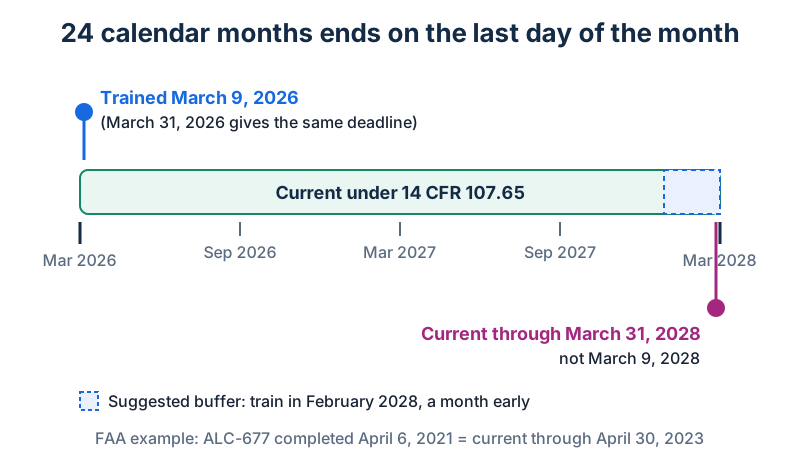 Currency counts in calendar months, so the day of the month you train doesn't matter. Only the month does.
| You passed the UAG or completed recurrent training on | You're current through |
|---|---|
| March 3, 2025 | March 31, 2027 |
| March 31, 2025 | March 31, 2027 |
| January 15, 2026 | January 31, 2028 |
| November 10, 2026 | November 30, 2028 |
Notice the first two rows. Training on March 3 and training on March 31 buy you exactly the same deadline. That's the one people miss on the test, too.
How to find your current deadline
Look at the date on the most recent of these: your passing UAG test report, or your latest FAASafety.gov recurrent completion certificate. Count forward 24 months to the same month, then go to the last day of that month. If you've lost both documents, your FAASafety.gov account keeps a record of completed courses, and you can reprint a UAG test report from your PSI account.
Can you take recurrent training early?
Yes, and there's no penalty. Your 24 months always count back from your most recent qualifying event, so completing training early simply resets the clock from the new completion month. The only cost of training early is the months you give up. Training in the last week before your deadline is a bad bet: a forgotten password, a site outage, or a failed exam attempt can push you over.
A good habit is to train in the second-to-last month of your window. If your deadline is March 31, 2028, train in February 2028. You give up about a month and gain room for things to go wrong.
Which recurrent course should you take: ALC-677 or ALC-515?
The FAA's remote pilot page (opens in a new tab) lists two recurrent options, both no-cost:
| Course | Who it's for | Cost |
|---|---|---|
| ALC-677, Part 107 Small UAS Recurrent | Anyone who holds a Part 107 remote pilot certificate, regardless of how they originally qualified or whether their currency has lapsed | Free |
| ALC-515, Part 107 Small UAS Recurrent – Part 61 Pilots | Only Part 61 certificated pilots (recreational, private, commercial, ATP) who have a current flight review | Free |
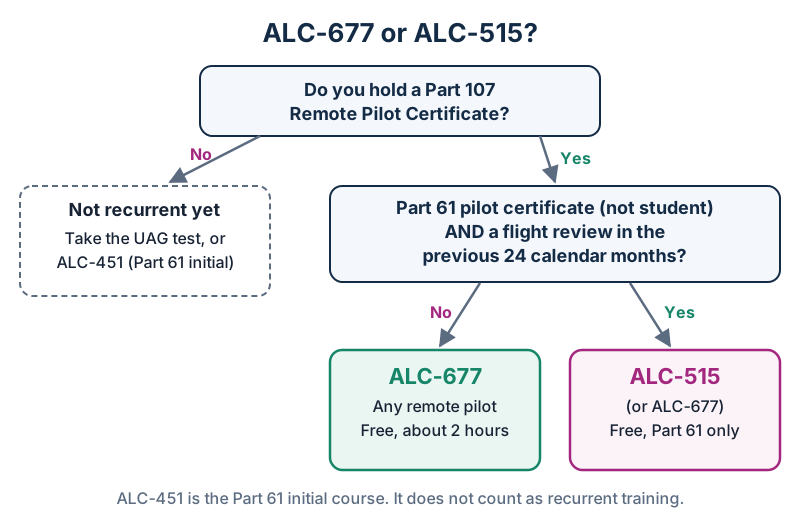 If you're unsure, ALC-677 is always valid for a certificated remote pilot.
Don't confuse either with ALC-451, Part 107 Small UAS Initial. That's the course Part 61 pilots take to earn the remote pilot certificate in the first place. It isn't recurrent training.
Part 61 pilots whose flight review has lapsed
If you're a private pilot whose flight review is more than 24 calendar months old, you no longer qualify for ALC-515. Take ALC-677 like any other remote pilot. Your Part 107 currency and your manned-aircraft flight review are separate clocks, and only one of them depends on the other.
How to complete ALC-677, step by step
The steps below follow the instructions on the ALC-677 course content page (opens in a new tab).
- Create or log into your FAASafety.gov account. Credit is only recorded if you're logged in and enrolled. Use your legal name, since it prints on the completion certificate.
- Open the ALC-677 course page (opens in a new tab) and enroll.
- Work through every chapter. You must view the introduction, each numbered chapter, and the review chapter. Use the course's own navigation bars, not your browser's back button.
- View the Reference Materials, Glossary, and Review pages. The FAA says these enable the Exam button.
- Take the exam in a single session. It's multiple choice. If it isn't completed and graded within 90 minutes, you'll need to retake the entire exam the next time you log in.
- Print or save your completion certificate. The course instructs you to "print the training completion certificate and retain it as proof of recency of knowledge."
The FAA estimates the training itself at about 2 hours. Block out three hours total and do it in one sitting if you can.
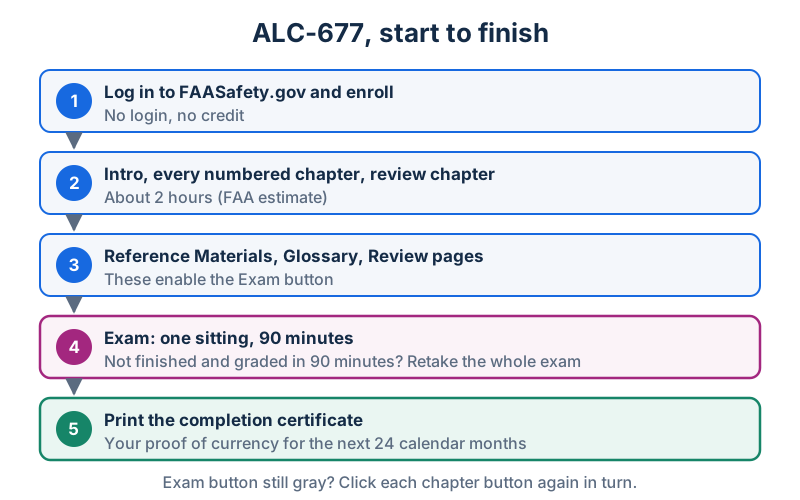 The ALC-677 sequence. The exam button stays gray until every earlier page is complete.
When the Review or Exam button stays gray
This is the most common support question, and the course page answers it: go back and click each chapter button in turn so it shows as completed. That activates Review, and Review activates Exam. If you closed the window partway through, log into FAASafety.gov, open your Courses In Progress page, and click Continue. Links inside the course can open extra windows on top of it; close them and return to the FAASafety.gov tab.
Tips for the online exam
- Don't start the exam on a phone with a weak signal. The 90-minute window keeps running.
- Review the chapter summaries right before you start. Once the exam begins, the 90-minute clock is the constraint, not the material.
- Read every answer choice. The distractors are built from real rules applied to the wrong situation, just like the initial test.
What does Part 107 recurrent training cover?
Recurrent training covers the same knowledge areas listed in 14 CFR 107.73 for the initial test: regulations, airspace and flight restrictions, weather, loading, emergency procedures, crew resource management, radio procedures, performance, drugs and alcohol, aeronautical decision-making, airport operations, maintenance and preflight inspection, and operation at night.
According to the course introduction, when you finish you should be able to identify:
- certification and recency requirements for a remote pilot
- characteristics of small UAS and exclusions from Part 107
- registration, marking, and aircraft condition requirements
- remote PIC responsibilities, supporting crew roles, and crew management best practices
- recommended maintenance and preflight inspection requirements
- operating requirements and limitations, and the waiver process
- abnormal and emergency situations
- accident reporting requirements
Topics worth refreshing before you start
If you passed your initial test a while ago, these are the areas that tend to have faded or changed:
- Night operations. Under 14 CFR 107.29, night flight needs anti-collision lighting visible for at least 3 statute miles, and the remote PIC must have completed the initial test or training after April 6, 2021. The same lighting is required during civil twilight.
- Operations over people. Four categories, each with its own aircraft requirements.
- Remote ID. Registered drones must comply, whether through built-in broadcast or a module.
- Airspace authorizations and waivers. How LAANC and FAADroneZone requests work.
- Accident reporting. Which accidents must be reported to the FAA, and the 10-day deadline.
The FAA regulations overview and the Part 107 study guide are quick refreshers, and the controlled vs. uncontrolled airspace lesson covers the airspace basics.
How do you prove you're current?
The FAA is direct about this. Completing the online course doesn't produce a new remote pilot certificate, because the certificate doesn't expire. In the FAA's words, "You must be able to show a copy of your certificate of completion as proof of currency." (opens in a new tab)
A practical setup:
- Keep a printed copy with your remote pilot certificate in your flight bag.
- Save a PDF on your phone and in cloud storage, so a lost bag doesn't erase your proof.
- Know what 14 CFR 107.7 requires. Whenever you fly under Part 107, you must have your remote pilot certificate and ID in your physical possession, and present them on request to the FAA, the NTSB, the TSA, or law enforcement. You must also make required documents available to the FAA on request.
- Put the deadline in your calendar with two reminders: two months out and one month out.
For businesses with several pilots
If you run a drone program, keep a simple roster: each pilot's name, certificate number, most recent qualifying event, and currency end date. Ask for a copy of each new completion certificate. Clients and insurers may ask for proof of currency, and having it ready saves a scramble.
What happens if your Part 107 currency lapses?
Your certificate stays valid, but you may not act as remote pilot in command under Part 107 until you're current again. Flying a Part 107 operation as RPIC while not current violates 14 CFR 107.65, and 14 CFR 107.12 extends the same requirement to anyone manipulating the controls on their own.
Getting current again is the same process as staying current: complete ALC-677 (or ALC-515 if eligible), and your 24 months start from that month. You don't need to visit a testing center. Passing the UAG again would also satisfy the rule under §107.65(a), but there's no reason to pay for it.
While you're lapsed, two options remain:
- Fly under someone else's supervision. Under 14 CFR 107.12(a)(2), a person may manipulate the controls if they're directly supervised by a current remote PIC who can immediately take direct control.
- Fly recreationally, if the flight genuinely qualifies, under the recreational exception: TRUST completion, a recreationally registered drone, and the community-based safety guidelines. See Part 107 vs. recreational flying.
Worked example: a lapsed pilot and a paid job
Dana passed the UAG on September 13, 2024, and never did recurrent training. Her currency ran through September 30, 2026. On November 4, 2026, a client books her for a roof inspection on November 6.
- She isn't current, so she can't fly the job as RPIC.
- She logs into FAASafety.gov that evening, completes ALC-677 in about two and a half hours, and passes the exam.
- She prints the completion certificate and saves a PDF to her phone.
- She's current from November 2026 through November 30, 2028, and flies the job on November 6.
If she'd discovered the lapse on the morning of the job, she'd have had to reschedule. That's the whole argument for calendar reminders.
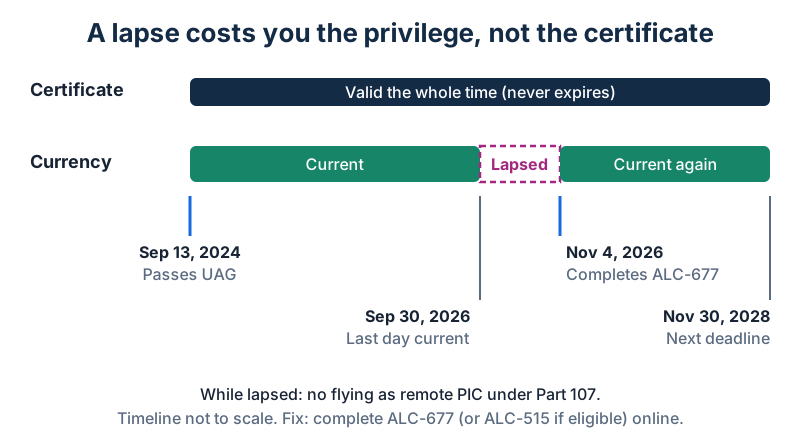 A lapse doesn't cost you the certificate, only the right to use it until you train again.
Part 107 recurrent training checklist
- Find your most recent qualifying date (UAG report or last completion certificate)
- Work out your deadline: the last day of the 24th calendar month
- Pick the course: ALC-515 only with a Part 61 certificate and current flight review, otherwise ALC-677
- Log into FAASafety.gov and enroll before you start, so the credit records
- View every chapter, then Reference Materials, Glossary, and Review
- Finish the exam in one sitting, inside 90 minutes
- Print the completion certificate and save a PDF copy
- Set reminders for your next deadline, two months and one month out
Practice question
A remote pilot passed the UAG knowledge test on March 3, 2025, and has done nothing since. On April 2, 2027, a client asks them to fly a paid job. What must they do first?
A. Nothing. Remote pilot certificates are valid for 36 months. B. Complete online recurrent training (ALC-677) before flying the job. C. Retake the UAG test at a testing center.
Show answer
Answer: B. Currency from a March 2025 test runs through March 31, 2027. On April 2, 2027, the pilot is no longer current under 14 CFR 107.65. The free online ALC-677 course restores currency without a testing-center visit. Choice A is wrong because the certificate doesn't expire, but currency lasts only 24 calendar months. Choice C would also satisfy the rule, but it isn't required and costs money.
Common mistakes
- Thinking the certificate "expires." It doesn't. Your currency does.
- Counting 24 months to the exact day. Currency runs to the end of the 24th calendar month.
- Taking ALC-515 without a current flight review. It's only for Part 61 pilots who meet the flight review requirement.
- Taking ALC-451 by mistake. That's the Part 61 initial course.
- Taking the course while logged out. You won't receive credit.
- Not saving the completion certificate. It's your proof of currency.
- Paying for "renewal." The FAA's recurrent courses are free. The full fee picture is in how much the Part 107 exam costs.
Frequently asked questions
How often is Part 107 recurrent training required?
Every 24 calendar months. Under 14 CFR 107.65, you must have passed the initial knowledge test or completed recurrent training within the previous 24 calendar months to act as remote pilot in command. Because the count uses calendar months, your currency runs to the last day of the month: training on any day in March 2026 keeps you current through March 31, 2028.
Is Part 107 recurrent training free?
Yes. Both recurrent courses on FAASafety.gov, ALC-677 for any remote pilot and ALC-515 for Part 61 pilots with a current flight review, are listed as no-cost by the FAA. The free online format replaced the paid in-person recurrent test on April 6, 2021. You don't need a paid renewal service; you only need a free FAASafety.gov account.
How long does the ALC-677 course take?
The FAA estimates about 2 hours for the training. After that comes a multiple-choice exam that must be completed in a single session; if it isn't completed and graded within 90 minutes, you'll have to retake the entire exam next time you log in. Plan on roughly three hours in total, without distractions.
Do I get a new Part 107 certificate after recurrent training?
No. The FAA doesn't issue a new remote pilot certificate, because the certificate doesn't expire. Completing the online course renews your recency of aeronautical knowledge for 24 calendar months, and the FAA says you must be able to show a copy of your certificate of completion as proof of currency. Keep it with your remote pilot certificate.
What if my Part 107 currency already expired?
Complete ALC-677, or ALC-515 if you're a Part 61 pilot with a current flight review, and you're current again from that month. You don't need to retake the knowledge test at a testing center, and your certificate remains valid throughout. Until you finish the training, you can't act as remote pilot in command under Part 107.
Can I take Part 107 recurrent training early?
Yes. There's no early-completion penalty. Your 24 calendar months always count from your most recent qualifying event, so training early simply restarts the clock from the month you complete it. Training a month or two before your deadline is a sensible buffer against login problems or a failed exam attempt.
Is ALC-677 the same as the Part 107 recurrent test?
ALC-677 is what replaced the recurrent test. Until April 6, 2021, remote pilots took an in-person recurrent knowledge test at a testing center. Since then, currency comes from the free online ALC-677 training (or ALC-515 for eligible Part 61 pilots), which ends with an online multiple-choice exam instead of a proctored test.
Next steps
Haven't earned the certificate yet? Start with how to get a Part 107 license. Already certificated and want a refresher before your recurrent exam? A timed run of the free Part 107 practice test shows quickly which areas have slipped since your initial test.
Sources
- FAA — Become a Certificated Remote Pilot (Keep Your Remote Pilot Certificate Current; last updated June 9, 2026)
- eCFR — 14 CFR 107.65 Aeronautical knowledge recency
- FAASTeam — ALC-677 Part 107 Small UAS Recurrent (course page)
- FAASTeam — ALC-677 course content and exam instructions
- FAASTeam — ALC-515 Part 107 Small UAS Recurrent – Part 61 Pilots
- FAA FAQ — Does the FAA issue a new remote pilot certificate after the online ALC course?
- FAASafety.gov notice — calendar-month currency example (ALC-677)
- FAA — Operations Over People General Overview (online recurrent training replaces in-person test)
- eCFR — 14 CFR 107.7 Inspection, testing, and demonstration of compliance
- eCFR — 14 CFR Part 107, Subpart C (§§107.61–107.74)