
Part 107 vs. Recreational Drone Rules: Which Ones Apply to You?
If you fly strictly for fun, you can fly under the recreational exception (49 U.S.C. 44809) with a free TRUST certificate, registration and a community-based organization's safety guidelines. If a flight has any other purpose, such as paid work, helping a business (even your own, even unpaid) or volunteering for an organization, you need a Part 107 Remote Pilot Certificate.
If you fly strictly for fun, you can use the recreational exception with a free TRUST certificate. If the flight has any other purpose, you need a Part 107 certificate. Under 49 U.S.C. 44809, recreational flyers pass TRUST, register and mark their drones, and follow a community-based organization's safety guidelines. Paid work, helping a business (even your own, even unpaid) or volunteering for an organization all fall under Part 107. The question is why you're flying, not whether money changes hands.
Key takeaways
- Purpose decides, not payment. The FAA says compensation "is not what determines if a flight was recreational." Unpaid flights that help a business or nonprofit are Part 107.
- You can't mix purposes in one flight. The FAA's AC 91-57D says a single flight can't be both recreational and commercial.
- TRUST is free, online and can't be failed. It covers recreational flying only. It is not a license for any other kind of flight.
- Part 107 means a proctored knowledge test (about $175), a Remote Pilot Certificate and recurrent training every 24 calendar months.
- New since 2024: education and research flights by schools count as recreational purposes, as long as every other recreational condition is met.
- When in doubt, the FAA says assume Part 107. It covers recreational flights too.
The one question that decides: why are you flying?
The recreational exception is an "operation-specific" carve-out. Each flight either meets every one of its conditions or it doesn't. The first and most important condition is that the drone is "flown strictly for recreational purposes." The FAA's recreational flyers page (opens in a new tab) is blunt: "Compensation, or the lack of it, is not what determines if a flight was recreational or not."
The FAA's Advisory Circular 91-57D (opens in a new tab) (June 2025) adds two points worth memorizing. Recreational purposes don't include "flights related to or in furtherance of a business." And "a person may not combine recreational and commercial purposes in a single flight." You can't call the first ten minutes fun and the last five a quick roof check for a client.
What the FAA says is not recreational
The FAA's own examples of flights that need Part 107:
- Taking photos to help sell a property or a service
- Roof inspections
- Taking pictures of a high school football game for the school's website
- Goodwill or volunteer work, such as surveying coastlines for a nonprofit
The pattern: if the flight benefits a business, an employer, a client or an organization's mission, it's not purely for your enjoyment.
What now counts as recreational: school education and research
The FAA Reauthorization Act of 2024 changed the exception. Per AC 91-57D, a "recreational purpose" now includes drones operated by elementary schools, secondary schools and colleges for educational or research purposes: instructing students, institution-approved research and similar academic activities. JROTC programs and CBO-chartered educational programs count too.
Two catches. The flights must still meet every other recreational condition, including TRUST and following a recognized CBO's safety guidelines. And this covers teaching and research, not marketing. The FAA still lists filming the football game for the school's website as a Part 107 flight.
Part 107 vs. recreational: side-by-side comparison
| Recreational (49 U.S.C. 44809) | Part 107 | |
|---|---|---|
| Purpose | Strictly recreational, plus school education/research | Any purpose, including business, work and volunteering |
| Knowledge requirement | TRUST: free, online, correctable to 100% | UAG knowledge test at a PSI testing center (about $175) |
| Credential to carry | TRUST completion certificate (paper or electronic) | Remote Pilot Certificate and photo ID |
| Minimum age | None for TRUST (per the AIM) | 16 for the certificate (14 to take the test) |
| Ongoing currency | None. TRUST is once-and-done | Free online recurrent training every 24 calendar months |
| Registration | $5 covers all your recreational drones for 3 years; not needed at 0.55 lb (250 g) or less | $5 per drone for 3 years; every drone, whatever its weight |
| Safety rules | Must follow a recognized CBO's safety guidelines | Must follow Part 107 |
| Altitude | 400 ft AGL max in Class G; can't add 400 ft from a rooftop | 400 ft AGL, or higher within 400 ft of a structure |
| Controlled airspace | Prior authorization via LAANC or DroneZone | Prior authorization via LAANC or DroneZone |
| Visual observer | Must be co-located with you; needed for FPV | Allowed; no co-location rule |
| Speed, visibility, clouds | Not set by statute; CBO guidelines apply | 87 kt (100 mph); 3 SM visibility; 500 ft below / 2,000 ft horizontally from clouds |
| Night flying | Only if your CBO's guidelines address night flight | Allowed with anti-collision lighting visible for 3 SM |
| Operations over people | Per CBO guidelines | Four defined categories with specific drone requirements |
| Going beyond the limits | Not possible. The flight must then follow the regular rules | Waivers available for many rules |
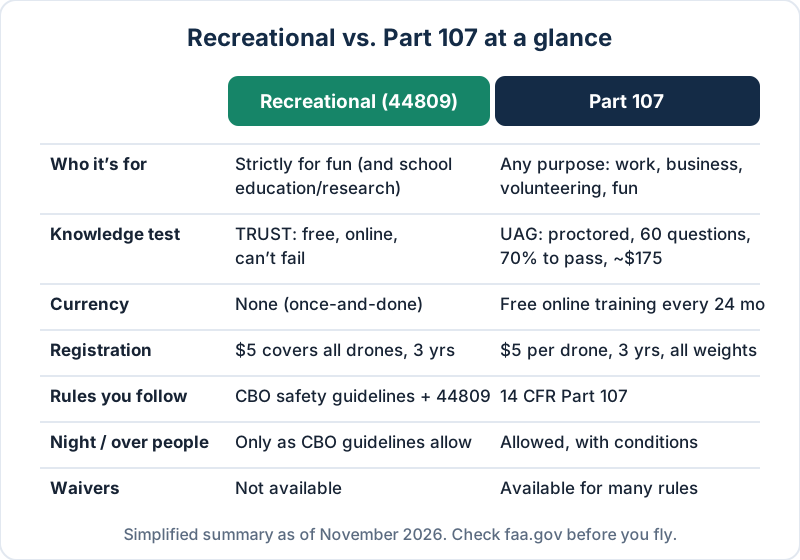 The short version of the table above. Purpose is the first fork; everything else follows from it.
The rules for recreational drone flyers under 44809
Per the statute and the FAA's guidance, a recreational flight must meet all of these:
- Fly strictly for recreational purposes (personal enjoyment, or school education/research).
- Follow the safety guidelines of an FAA-recognized CBO. You don't have to be a member, but you should be able to tell an FAA inspector or police officer which CBO's guidelines you're flying under.
- Keep visual line of sight, yours or a visual observer's who is co-located with you and in direct communication. AC 91-57D says a VO is necessary if you fly FPV goggles.
- Give way to and don't interfere with manned aircraft.
- Get prior authorization before flying in Class B, C or D airspace, or in surface-area Class E for an airport, through LAANC (opens in a new tab) or DroneZone. Not sure what's controlled? See controlled vs. uncontrolled airspace.
- Stay at or below 400 ft AGL in Class G, and obey TFRs and special-use airspace. "Ground level" means the ground, not a building, so you can't launch from a 10-story roof and climb another 400 ft.
- Pass TRUST and carry proof.
- Register and mark the drone if it's over 0.55 lb (250 g), and carry proof of registration.
Fail any one of these and the flight no longer qualifies. It must then follow the regular rules, which for a drone under 55 lb means Part 107.
A few edge cases from AC 91-57D: a recreational drone over 55 lb may fly only at an approved fixed site under a CBO's FAA-approved guidelines. And you may fly at night only if the CBO guidelines you're following actually address night flight.
The TRUST certificate: what it is and isn't
The Recreational UAS Safety Test (opens in a new tab) is free and online through FAA-approved test administrators (16 are listed as of August 2026). Every question can be corrected until you get it right, so you can't fail. The FAA's Aeronautical Information Manual (opens in a new tab) says there's no minimum age and that TRUST is once-and-done, with no recurrent test.
Save your certificate the moment you finish. Administrators don't keep records, and the FAA says that if you lose it, you retake TRUST. A photo on your phone is fine; the proof can be paper or electronic.
What TRUST doesn't do: authorize any non-recreational flight. It's not a "drone license," and it doesn't count toward Part 107.

An FAA webinar on TRUST for recreational flyers, recorded in July 2022. The basics still hold, but it predates AC 91-57D and the 2024 law changes covered above.
Registration and Remote ID for recreational flyers
Recreational registration on FAADroneZone (opens in a new tab) costs $5, covers every drone you own and lasts three years. Drones at 0.55 lb (250 g) or under don't need it when flown recreationally. Any drone that's registered must also broadcast Remote ID, unless you fly it inside an FAA-Recognized Identification Area (FRIA).
The catch people hit later: the FAA says registrations can't be transferred between the two types, and a drone registered under the recreational exception can't be flown under Part 107.
What Part 107 requires
To fly under 14 CFR Part 107 (opens in a new tab), you need a Remote Pilot Certificate. (New to the rule itself? Start with what Part 107 is and who it covers.) You must be at least 16, pass the FAA's UAG knowledge test at a PSI testing center, apply through IACRA and clear a TSA security check. Current Part 61 pilots with a flight review can take a free online course instead of the test. The full steps are in how to get a Part 107 license, and the costs are in Part 107 exam cost.
Once certificated, you follow Part 107's operating rules, including the limits in 14 CFR 107.51 (opens in a new tab), register each drone individually, and complete free recurrent training every 24 calendar months (see Part 107 recurrent training). For a full rules overview, read FAA drone regulations.
What Part 107 lets you do that recreational flying doesn't
- Fly for any purpose: clients, your own business, your employer, a nonprofit.
- Fly at night under the rule itself, with anti-collision lighting.
- Fly over people under the four defined categories, without relying on CBO guidelines.
- Go above 400 ft near a structure, staying within 400 ft of it and no higher than 400 ft above its top.
- Use a visual observer who isn't standing next to you, as long as you can communicate effectively.
- Apply for waivers for many rules, such as operating beyond visual line of sight.
Which rules apply to you? A decision flowchart
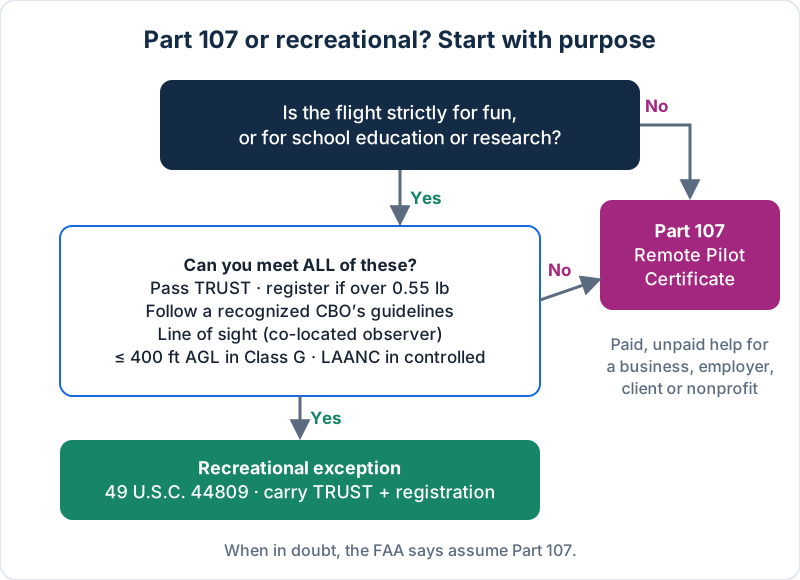 Start at the top and answer honestly. Any "no" sends you to Part 107.
Still unsure? The FAA's User Identification Tool (opens in a new tab) asks a few questions and tells you which rules fit.
14 real-world examples: Part 107 or recreational?
| Scenario | Rules | Why |
|---|---|---|
| Flying at the park on a Saturday just to enjoy it | Recreational | Purely for fun |
| Shooting your neighbor's house for their listing, for free | Part 107 | FAA example: photos to help sell a property |
| A real estate agent shooting their own listing | Part 107 | Furthers a business, even with no client paying |
| A roofer checking a customer's roof before quoting | Part 107 | FAA example: roof inspections |
| Volunteering to map a trail for a nonprofit | Part 107 | FAA example: goodwill counts as non-recreational |
| Filming the high school game for the school's website | Part 107 | FAA example |
| A high school class flying drones to learn aerodynamics | Recreational (education) | Covered since the 2024 law, if all other conditions are met |
| An employee checking the warehouse roof for the boss | Part 107 | Flight is for an employer |
| FPV racing at a club field with a spotter beside you | Recreational | Fun, with a co-located visual observer |
| Flying for fun at night | Recreational, only if your CBO's guidelines cover night | AC 91-57D |
| Flying a 60 lb hobby aircraft for fun | Recreational only at an approved fixed site | AC 91-57D, 44809(c) |
| A Part 107 pilot flying on vacation, no TRUST | Part 107 rules | AIM: certificate holders may fly recreationally under Part 107 |
| Starting a flight for fun, then shooting a client's property | Part 107 for the whole flight | Purposes can't be combined in one flight |
| Filming for a channel you run as a business | Assume Part 107 | Flights "in furtherance of a business" aren't recreational |
The gray areas
Some situations don't have a crisp FAA answer: posting hobby footage to a personal social account, selling a clip later that you shot for fun, or doing a favor for a friend. The FAA's guidance points to the purpose at the time of the flight and says each case is judged on its own facts. Ask yourself whether the flight was planned to benefit a business, a client or an organization. If yes, or if you can't say no with a straight face, use Part 107. That's the FAA's own advice: when in doubt, assume Part 107.
Can a Part 107 pilot fly recreationally?
Yes, two ways, per the AIM. You can fly a recreational flight under Part 107 and follow all Part 107 rules, with no TRUST needed. Or, if you want to fly under the recreational exception instead, you must pass TRUST and follow every 44809 condition, including CBO guidelines. Watch the registration: a drone registered as recreational can't be flown under Part 107.
Moving from recreational flying to Part 107
If you're a hobby pilot about to take paid work, here's the switch:
- Get an FAA Tracking Number in IACRA and book the UAG test with PSI.
- Study. Your stick skills help, but the test is about charts, weather and rules. Our Part 107 study plan has 1-, 2- and 4-week schedules, and how hard the Part 107 exam is covers format and pass rates.
- Pass, apply in IACRA and clear the TSA check.
- Register each drone you'll fly for work under Part 107 ($5 each).
- Put a recurrent-training reminder 24 calendar months out.
A timed run on our free Part 107 practice test is a quick way to see how far you are from passing. If you want structured lessons, the Part 107 course walks through every test area.
Practice questions
Question 1: Your neighbor is selling their house and asks you to take a few drone photos for the listing. They aren't paying you, and you'd enjoy the flight. Which rules apply?
A. The recreational exception, because no money changes hands B. Part 107, because the flight's purpose is to help sell a property C. Neither, because flights over private property are exempt
Show answer
Answer: B. The FAA says compensation doesn't determine whether a flight is recreational, and it lists "taking photos to help sell a property" as a Part 107 example. Enjoying it doesn't change the purpose. C is wrong: federal airspace rules apply over private property too.
Question 2: A recreational flyer wants to fly FPV goggles in Class G airspace. What does the FAA's guidance require?
A. Nothing extra; FPV is allowed alone below 400 ft B. A visual observer co-located with the pilot and in direct communication C. A Part 107 waiver for beyond visual line of sight
Show answer
Answer: B. AC 91-57D says a VO is necessary for FPV under the recreational exception, and the VO must be co-located and in direct communication. A ignores the line-of-sight condition. C confuses the recreational exception with Part 107 waivers.
Common mistakes
- "I'm not getting paid, so it's recreational." Purpose decides, not payment.
- Flying a recreationally registered drone for a job. Register it under Part 107 ($5 per drone) first.
- Treating TRUST as a license. It covers recreational flying only.
- Assuming sub-250 g drones are exempt from everything. They skip recreational registration, but every recreational rule still applies, and under Part 107 they must be registered.
- Calling only part of a flight "work." One flight, one purpose.
- Letting Part 107 currency lapse. The certificate doesn't expire, but your privileges do without recurrent training.
Frequently asked questions
Do I need a license to fly a drone for fun?
No. To fly purely for fun, you need a free TRUST completion certificate, not a Part 107 Remote Pilot Certificate. You must also register drones over 0.55 lb (250 g), mark them, broadcast Remote ID if registered, follow a recognized CBO's safety guidelines and get authorization before flying in controlled airspace.
What is the difference between TRUST and Part 107?
TRUST is a free, online, can't-fail safety test that lets you fly strictly for recreation. Part 107 is a full Remote Pilot Certificate earned by passing a proctored 60-question FAA knowledge test, which lets you fly for any purpose. Part 107 also requires recurrent training every 24 calendar months; TRUST is once-and-done.
Do I need Part 107 if I don't get paid?
Often, yes. The FAA says compensation doesn't decide whether a flight is recreational. Unpaid flights that help sell a property, support your own business, serve your employer or volunteer for a nonprofit all need Part 107. Only flights strictly for personal enjoyment, or school education and research, qualify as recreational.
Can a Part 107 pilot fly recreationally without TRUST?
Yes, as long as you fly the recreational flight under Part 107 rules. The AIM says a Part 107 certificate holder may fly recreationally under Part 107 but must follow it entirely. To fly under the recreational exception instead, with CBO guidelines, you must pass TRUST first.
Does TRUST expire?
No. The FAA's AIM describes TRUST as once-and-done, with no recurrent test. But administrators don't keep records, so if you lose your certificate you'll have to retake the test. It's free and can be retaken any time, so save a copy on your phone and a backup.
Can I fly my drone at night recreationally?
Only if the community-based organization safety guidelines you're following address night flight. AC 91-57D says you may only conduct the types of operations those guidelines cover. Under Part 107, night flight is allowed by the rule itself, with anti-collision lighting visible for 3 statute miles.
Can I fly a recreationally registered drone for work?
No. The FAA says a drone registered under the recreational exception can't be flown under Part 107, and registrations can't be transferred between the two. Before any Part 107 flight, register that drone under Part 107 on FAADroneZone. It costs $5 per drone and lasts three years.
Sources
- FAA — Recreational Flyers & Community-Based Organizations (last updated Oct 29, 2026)
- FAA — The Recreational UAS Safety Test (TRUST) (last updated Aug 21, 2026)
- FAA — Advisory Circular 91-57D, Exception for Limited Recreational Operations of Unmanned Aircraft (6/24/25)
- FAA — Aeronautical Information Manual 11-5-1, UAS Pilot Certification and Requirements for Part 107 and Recreational Flyers
- FAA — How to Register Your Drone
- FAA — User Identification Tool
- FAA — Become a Certificated Remote Pilot
- FAA — UAS Data Exchange (LAANC)
- eCFR — 14 CFR 107.51 Operating limitations for small unmanned aircraft
- eCFR — 14 CFR Part 107
- FAA (YouTube) — Flying Drones for Fun: Is TRUST a Must? (webinar, July 28, 2022)